
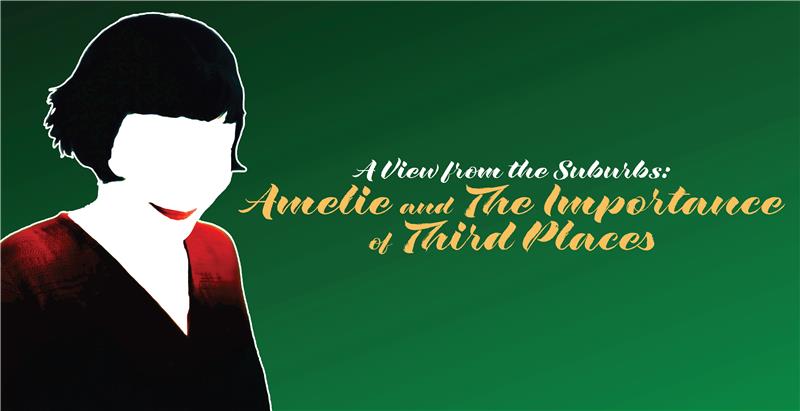

Jean-Pierre Jeunet’s 2001 film Amelie begins by describing the movements of a blue fly one day in 1973, and it only grows more whimsical from there. The film follows its namesake, 23-year-old Amelie Poulain, a shy and imaginative young waitress living in Paris. One night, Amelie finds a 40-year-old time capsule behind a tile in her bathroom; her quest to reunite the capsule with its maker while ensuring that she remains anonymous leads her on a fantastical caper across the city, one which will change her life.
The principal events of Amelie unfold in three locations: Amelie’s apartment building, the Two Windmills Café where she works, and the Paris metro station she travels through every weekend to visit her father. All three locations are home to wonderfully weird supporting characters; Raymond Dufayel, a housebound painter obsessed with copying Renoir’s Luncheon of the Boating Party, Lucien, a long-suffering grocer’s assistant, Georgette, Amelie’s hypochondriac coworker, Joseph, a jilted lover who stalks his ex-girlfriend daily in the café, and Nino Quincampoix, a young man who collects discarded photos from a booth in the station. Over time, the withdrawn Amelie develops relationships with each character and eventually learns that her purpose is not just to help others, but to be seen by them too. The physical environment of Amelie’s Paris is central to the main character’s journey, because the locations in which the story takes place are third places.
In sociology, the “third place” is defined as a center of community, separate from the “first place” (where one lives) and the “second place” (where one works or studies). The Two Windmills Café serves as a third place for Joseph, who begins the film spending hours each day stalking his ex-girlfriend, Gina. Amelie’s boss inspires her to subtly set up Joseph and Georgette’s relationship, which develops entirely within its walls. Later in the film, the café is the first place where Nino recognizes Amelie, signaling the beginning of their relationship.
The second third place is the nearby metro station. Amelie meets Nino at the photo booth, and the pair feel an instant connection. However, before it can develop, Nino runs off, losing one of his photo albums. Amelie is fascinated by the collection, and she engages in a benevolent cat-and-mouse game across the city to secretly return it to him. As their interest in each other grows, the metro and the photo booth are central to Amelie and Nino’s relationship; the only way Nino can communicate with the illusive Amelie is through leaving flyers in the station and reading messages she leaves on torn-up photos.
The final third place is Raymond Dufayel’s apartment. It is here that Amelie quietly reveals her loneliness, identifying with a young woman in his painting. Raymond assists Amelie in her quest to return the time capsule, and from his window he secretly observes her activities, including her defending Lucien from his abusive boss. A videotape from Raymond and Lucien (filmed in the apartment) finally gives Amelie the courage to reveal herself to Nino and find the connection she has been longing for.
These real, even mundane locations have a fantastical character in the Amelie universe. Jeunet and cinematographer Bruno Delbonnel employ a variety of cinematic tricks to create the world of the film. Dutch angles, wide-angle lenses, almost technicolor red, green and yellow color grading, moments of frenetic editing using stock footage, and jump cuts present an atmosphere which is obviously artificial. However, this visibly make-believe quality presents a social critique: if Amelie’s world is fantastical enough to belong to the realm of imagination, does that mean that its joy is inaccessible in real life? As an American who has lived my whole life in suburbs devoid of third places, it was easy for me to feel that way after watching the film. A 2021 Harvard study found that 61% of young American adults experienced “serious loneliness”, and the loss of third spaces is an important factor. Though the film is lighthearted, Amelie’s loneliness is visible throughout. Her resulting imagination and love of simple pleasures is what makes the story endearing, but her character is profoundly shaped by lifelong isolation.
In Amelie’s case, she can overcome this isolation by accessing a community in the third places around her, but what about the rest of us? Sociologist Ray Oldenburg coined the term “third place” in his 1991 book, The Great Good Place and noted that third places were already in decline. This was twenty years before smartphones became ubiquitous and forty years after suburban sprawl defined the American environment, so social media and geography aren’t the only things to blame for growing American isolation. Beginning in the 1970’s, wages stagnated, leaving workers with less money and free time, and privatization and offshoring killed many local businesses. Over time, those that remain have become hostile to socializing; I can’t go anywhere in my neighborhood without seeing signs prohibiting “loitering”, and once you enter a business, there’s an understanding that you need to buy something or get out. Contrast this with the fantastical urban environment of Amelie’s Paris. Amelie walks or takes the metro everywhere, and even though the Two Windmills is a business, many regulars spend hours there without buying more than a cup of coffee.
I know I’m not making a one-to-one comparison here. Amelie is a movie, and an unrealistic one at that. After all, the crew famously removed trash and graffiti prior to filming, concealing Paris’ rough edges to serve the film’s imaginative setting. No place is perfect, and whatever route the U.S. takes to become more connected won’t be easy. I don’t have immediate solutions, but I do know that life can imitate art, and I believe a world with more third places would be a significantly happier one. Amelie is absorbing and imaginative, even escapist, but it can also inspire us to connect with each other, and to keep dreaming of a world where that connection is just a bit easier.