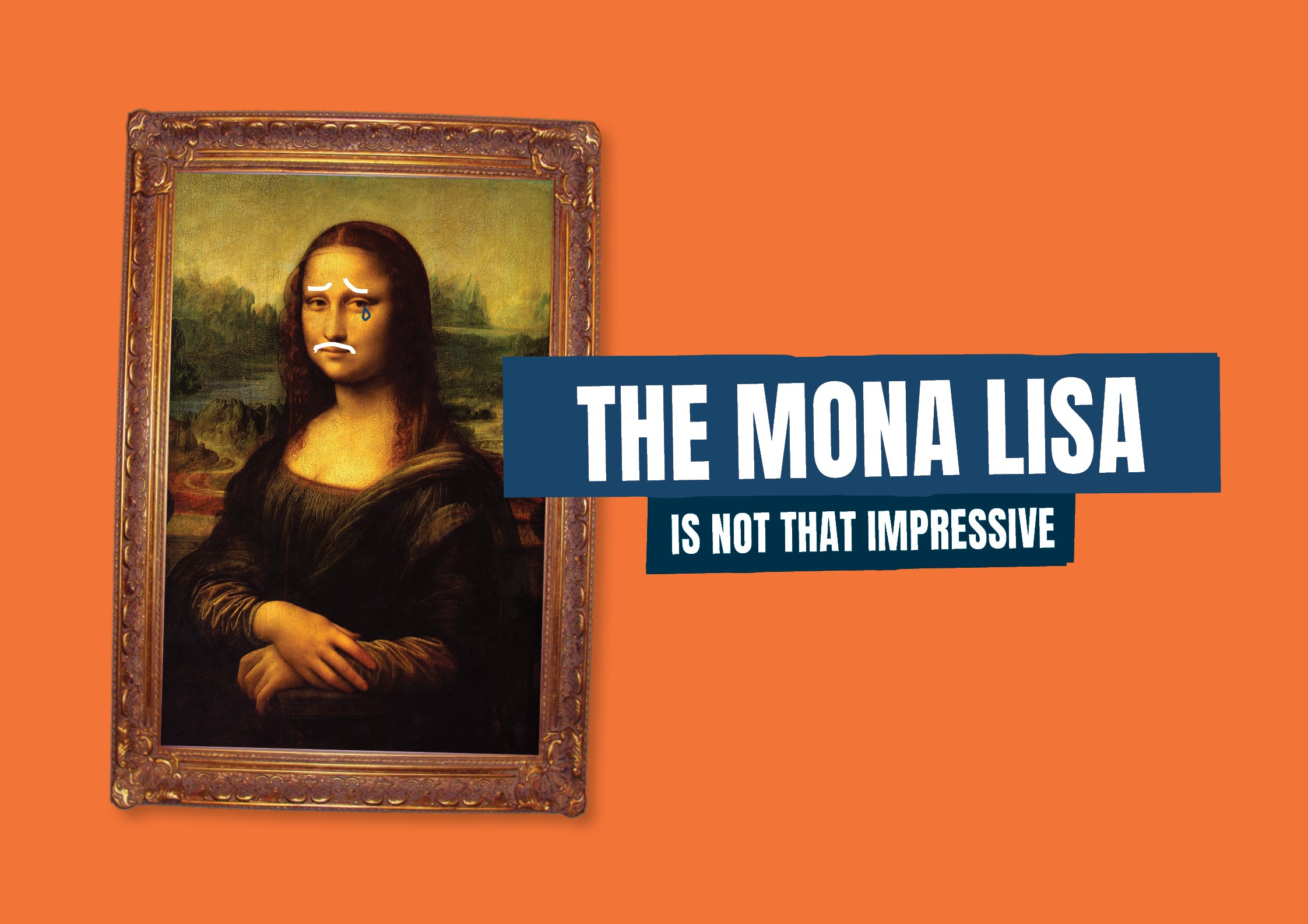
At least not for the reasons that most people think. Mona Lisa has often been credited for both her beauty and mystery, unarguably one of Leonardo Da Vinci’s most famous pieces. However, visually, it’s not even one of his more provoking works. I myself am partial to his sketches (even those that remain unfinished) that greatly demonstrate his position as a polymath, rather than simply an artist, to which he is so commonly reduced. Mona Lisa is Da Vinci’s masterpiece for what she represents. The creation of a student of anatomy and science. A proverbial Frankenstein’s monster made with paint, math and brought to life by scientific progress. Truly the Lady of the Renaissance; an age of enlightenment, the rebirth.
The Renaissance itself spanned the 14th to 17th centuries and defined itself with a pervasive interest in humanism, cultural development, and intellectual achievement. It is a bridge in time between an age characterised by religion and feudalism to an epoch that emphasised an individual interpretation of faith, science and a reformed western civilisation. It centered the human experience in artwork and theory and began a cultural shift towards individualism. Neoplatonic ideals that strove for beauty in form and composition. This was one of the first times in history we were the own subjects of our portraits instead of gods, monsters or saints. Where we saw ourselves as worthy of being painted, in many ways immortalised. Neoplatomic artwork tried to bridge the gap between the earthly and the divine. We depicted the Gods as human beings, not only to make worship more accessible, but also because we couldn’t imagine a more perfect form for them to take. Further evidence that at every point in time humankind has loved to place itself in proximity to divinity.
In many ways, Da Vinci’s crowning achievement is inextricable from the time she was made. The Renaissance was characterised by art, yes, but more important still was the philosophies behind said art. It’s why so many of those paintings have survived hundreds of years of passing hands. Despite being so well-known, art historians agree on very little. She’s thought to be the wife of a Florentine merchant or maybe an Italian noble woman, in any case, now entombed in the Louvre where hundreds of people visit her every day. Opposite her is The Wedding Feast At Cana by Paolo Veronese which is scaled at around 70 square meters, yet despite this (and many other breathtaking works of art) she remains their most popular attraction. There have always been bigger, louder things around her, yet she’s captured our attention for the better part of five centuries: a visage of human ingenuity and sfumato. Da Vinci was a pioneer in many fields and so much of what we take for granted in our lives today can be traced back to the work of hungry minds like his. In addition to his paintings, he sketched plans for weapons of war. He was obsessed with flight and often drew flying machines based on his observations of birds in early years.
The Mona Lisa is certainly a beauty, but she’s also a relic dug up from a grave. Da Vinci used to illegally exhume corpses to study the placement of muscles under the skin. The jigsaw of the human skeleton. In painting, it allowed him to build bodies from the bones up. Yet another of his great feats in engineering. She’ll be smiling the same way for many, many years. She’s a representation of Da Vinci’s talent but also the enormity of the idea of ‘cultural rebirth’. The impact that those ideologies had and continue to have. In many ways, hers is the face we think of when we say ‘art history’ so it makes sense that she is my own first installment.