

I try to avoid watching the news these days.
Whenever I do it just seems like a sickening tableau of ruin. A macabre parade before the end of the world with grand marshals who sit in ivory towers and feed off the flesh of the masses beneath them. More and more I think that I should probably re-read Dracula, Macbeth and The Hunger Games because I don’t consume enough non-fiction.
Most apocalypses, in their respective mythos, are said to be heralded by myriads of ill omens. Christian texts describe plague, famine and pestilence. Hollywood favours a horde of shambling, hungry corpses. The breaking of Fenrir’s chains was one of many events that the Norse imagined would bring about a final fight in which many of their own gods were destined to die. In almost every story, there is a flood. That is to say that doomsday is not a quiet, isolated event. It’s a continuation, a constant. In our world, right now, children are dying and starving. We’ve built bombs that can level cities. There are giant concrete domes in the pacific leaking radiation into the ocean. We have a word used to describe the systematic eradication of a group of people with intent to make them extinct: genocide. That word exists because it’s happened before. Many times. And it’s still happening. The list of potential omens grows every time I return to it.
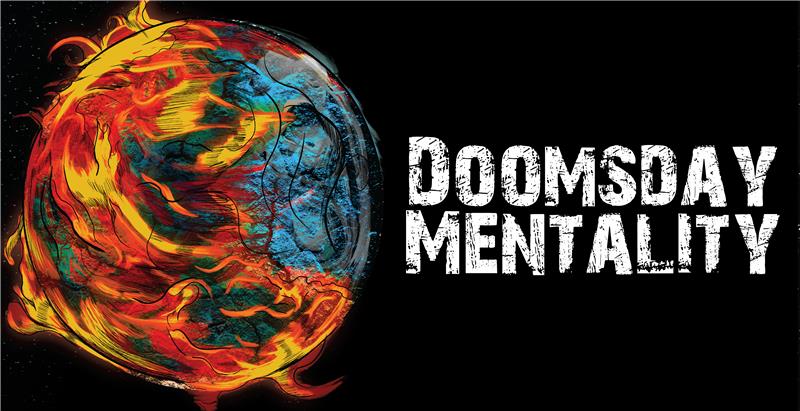
‘Doomsday mentality’ is the term rooted in a phenomenon of existential fear and often manifests itself through extreme anxiety surrounding current events or potential futures. When we turn on the news and look at the 21st century sometimes the apocalypse starts to look familiar. It’s only natural that there will be a corresponding rise in moral panic, social tension, and extremist ideology. One of the biggest demons in this phenomenon — to the great surprise of absolutely no one — is social media. Unarguably, media of every form is a large contributor to both good and bad aspects of society. On one hand, it allows us to communicate on a greater scale than we have ever been able to before. We are exposed to so many new ideas and the people behind those ideas that it can get extremely overwhelming. Social media allows us proximity to the rest of the world in a way that makes the daily news cycle seem more intimate. No longer is it something we can choose to ignore. It confronts us. Demands our attention and our participation. On the other hand, engaging in selective consumption of ideas means it’s easy to get lost in what we consider to be ‘safe’ spaces. To treat echo chambers as empirical evidence.
Potentially, the inclination to shy away from the strong opinions of others, especially those we disagree with, is an evolutionary response; a social fight-or-flight that’s only manifested in the last few decades. An effort to protect ourselves from ideas that we believe do some sort of tangible harm. It speaks to the greater issue of othering. It’s entirely too easy to ask: why us? In 1947 the Bulletin of Atomic Scientists (founded by those involved with the Manhattan Project) created a grisly symbolic timer. The Doomsday Clock, where midnight was the point of ‘annihilation’ due to threats posed by nuclear weapons, climate change and technological destruction. As of January 27th, 2026, the clock was set to 85 seconds until midnight. In this sense, it’s easy to demonise the ‘other’. To point blame towards a specific individual or group of individuals because it’s easier than admitting to the enormous amount of systemic change than needs to happen. Unfortunately, there is exclusion at the heart of everything. Culture revolves around belonging. To identify as one group, we must distinguish ourselves from another, and globally there seems to be an increased focus on individual gain rather than collective loss. Inaction is so easy sometimes. We are our own social architects and, like every architecture student I’ve ever met, we are prone to procrastination until the last minute.
Too often I think about the Golden Record. Aboard Voyager 1 where it’s been for nearly half a century now. Off in the far recesses of our solar system; 115 photographs, greetings in different languages, 90 minutes of music and a record of sounds intended as proof-of-life. An intergalactic time capsule, documenting such a small piece of human achievement. We excel at recording our own triumphs as well as broadcasting our own proposed collapse. I can look back at a whole history full of ‘almost’ and wonder how many times the world — in all its millions of years of history — could have ended and didn’t. The thing that so often gets lost in all the noise is the fact that there are still good things happening in the world. You just have to look for that type of news while the other is pushed by the algorithm; many of the recent positive environmental statistics were result of the anthropause (and subsequent pollution reduction) during the worldwide Covid lockdown. Scientists are putting massive effort into recent stem cell research and are working toward cures for different autoimmune diseases, including lupus. After more than a century the Seine is safe to swim in again. The hole in the Antarctic Ozone layer is steadily growing smaller. If I actively search, the list of things that give me hope grows slowly longer.
This epoch, the Anthropocene, is characterised by the irreversible scale of how we have acted on our environment. It’s a result of immense changes we have wrought on the world around us. We’ve barrelled through scientific advancement so fast that we’ve made ourselves acutely aware of our own destructive capacity. The question of ‘should we?’ becomes a divisive (sometimes violent) line in the sand. I believe that one of the things holding us back from major positive change is our perceived scale of global consequence. A failure to accurately analyse cost/benefit. A result of data that’s skewed or confounded by the massive scale and quantity of variables. According to the World Population Review in 2026 there are approximately fourty countries actively engaged in war or some other kind of armed conflict — suddenly taking public transport to reduce fossil fuels seems so insignificant. After all — we’ll all be dead at some point. After all — there are so many OTHER things to worry about. What’s the point of working to stop one large scale disaster if there’s another one waiting right around the corner? Maybe the overall problem with the doomsday mentality is that it’s just another self-fulfilling prophecy.