

Jacob Elordi and Margot Robbie are having sex again, but now it’s happening in a scene written by a chatbot that has never wanted anything in its life. It looks like a story: there’s rhythm, description, a beginning and an end. But nothing is at stake. No one is there behind it. Hollywood is doing a slower version of the same trick. Novels become films, films become franchises, and each time the edges get shaved off so the story can fit neatly into a trailer and a test screening. Endings are flipped, motives softened, uncomfortable questions swapped out for a final speech about hope. The audience walks out feeling satisfied, and the original story is left somewhere behind the closing credits, unable to object.
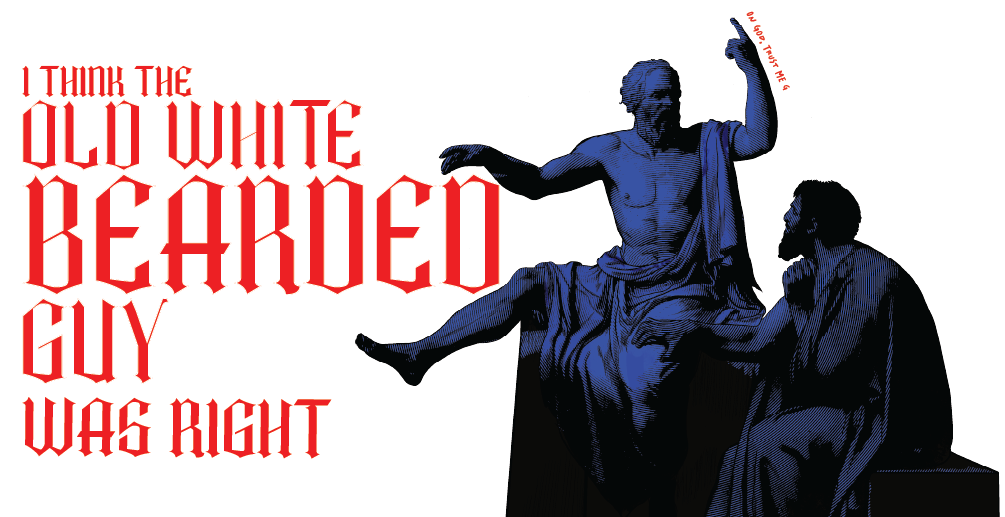
Socrates predicted this, long before cinema and long before AI. He didn’t write anything himself. Everything we have of him comes from his student Plato. In one dialogue, Phaedrus, Socrates tells a myth about a god who invents writing and offers it as a gift. Writing, the god says, will help people remember and make them wiser. The king listening to him isn’t impressed. It won’t deepen memory, he says, it will weaken it. People will rely on marks outside themselves instead of holding ideas in their minds. They’ll be able to repeat words without really understanding them. That is the part Socrates can’t stand: the way writing can look like thought without anyone there to answer back. Once it’s written, it always says the same thing. It cannot adjust, clarify, or defend itself when misunderstood. Once released into the world, it wanders from reader to reader without its author, vulnerable to misreading and misuse. Socrates imagines philosophy instead as a kind of live, risky speech: the speaker must stand there, answer objections, and tailor their words to the soul in front of them. Writing, by comparison, is a beautiful but dangerous counterfeit – something that looks like thinking but can’t quite think back.
Film adaptations show exactly what he meant. Take a novel that is strange, nasty, or morally complicated on the page, and watch what happens when it’s turned into a movie. The structure is simplified. Characters become more likeable. Violence is softened into “tragic romance.” The mess is cleaned up because mess doesn’t sell as well. My Sister’s Keeper is a textbook example. The book is built on an awful, sticky ethical problem. The film changes the ending entirely to give audiences something easier to swallow. The author didn’t even know the ending had been rewritten until after the fact. Her own story now exists in public mainly in the version she didn’t choose. That’s Socrates’ nightmare in 120 minutes: a fixed text that can’t stand up and say, “You’ve got me wrong.”
Generative AI takes this further. Writing already lets us store thoughts outside ourselves. AI offers to think for us as well. Why wrestle with research, fucking around and finding out, or thinking for yourself for once when you can get it in seconds? Why remember an argument when you can have a system produce one for you on demand? We get polished paragraphs and clean dialogue without having to do the work of understanding. The result is a new kind of emptiness. The AI doesn’t know what it’s saying, but it sounds convincing. The fanfic looks like a story, but no one had to live with it, change their mind about it, or defend it. The cost is subtle: our memory and attention soften. You don’t have to hold the shape of a story in your head if you can always prompt a new one. You don’t have to struggle to recall how a philosopher argued or how a novel ended if a summary appears the moment you ask. Learning becomes less about absorbing something into yourself and more about knowing which words to type so it appears on the screen.
Maybe the answer is not to throw out our tools but to refuse the easy way of using them. Reading a book after watching the film, noticing what was cut and why, is a way of letting the original writer back into the room. Using AI as something to push against instead of a shortcut — editing, questioning, rejecting what it gives you — keeps you in the act of thinking. Socrates worried that fixed words would make us passive, that we would stop talking to each other and start accepting whatever was handed down. Today our danger isn’t just writing, but the way Hollywood and AI freeze stories into smooth, repeatable products. If he was right, the most radical thing we can do is simple: keep the story alive by arguing with it. Don’t let the movie, or the algorithm, have the final word.