
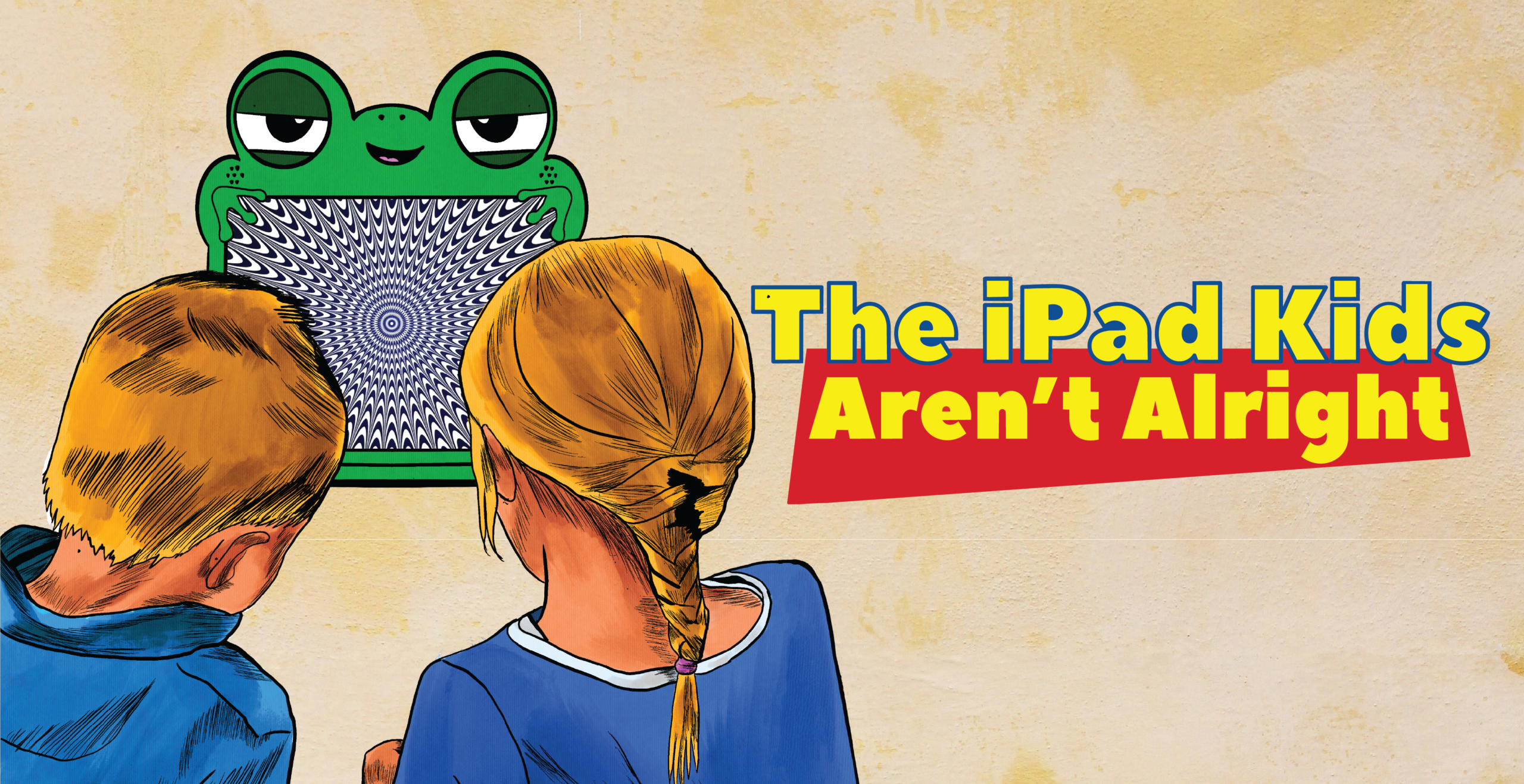

A New Plymouth primary school has phased out the use of iPads for students in years one to four.
Omata School was one of the first in the country to adopt the use of devices in the classroom, but Principal Karen Brisco is now not so convinced that they are as helpful to learning as educators once thought.
“I kept thinking ‘I wonder if we should give them a rest and see how it goes’ because the research was concerning about the type of learning and depth of learning that children do on screens.”
Brainrot: it’s in the name
Omata School’s decision was not made purely with anecdotal evidence. A paper published in the Waikato Journal of Education seems to agree that the costs of using screens for learning outweighs the benefits.
Children’s learning pathways are simply not activated when using digital devices in the same way as when using pen and paper.
Furthermore, excessive screen time has been associated with behavioural issues in young children, particularly in terms of self-control and attention spans.
Part of the issue is that when schools introduce devices in the learning environment, screen time doesn’t end when students leave the school gates.
Schools can’t afford to provide devices for every single student. Around 2009, Orewa College went around this by asking parents to buy devices for their school-aged children to use in school. This set off a BYOD (Bring Your Own Device) trend, which was a lot more expensive than the other kind of BYOD. More on the expensive part later.
By 2019, 48% of schools in Aotearoa adopted BYOD policies. With more and more students owning their own devices, young people in New Zealand have the highest rates of digital technology use – both educational and recreational – in the world.
Recreational screen time is arguably one of the most concerning effects of devices in schools, and not just because we now have kids that won’t shut up about Tung Tung Tung Sahur. We’ve ended up with a generation of people essentially raised, unsupervised, on the darkest parts of the internet.
It really is that damn phone
Considering the fact that it’s the year 2026 and this is a student magazine, there’s a higher-than-average chance that you are one of those gosh darn Gen Z whippersnappers that was placed in front of a laptop or iPad at the ripe age of eight years old. But for the sake of older readers, let me confirm for you that the risks of pornography exposure and online grooming were and still are very real threats, not just media fearmongering. There’s also the whole “manosphere” thing, which is setting feminism further back every day, while the rest of the alt-right pipeline undoes years of anti-racist advocacy,
\When devices first started infiltrating schools, most parents weren’t even aware of the potential dangers their children would come across. Nowadays, there’s less of an excuse to let your kids run free on the internet, but even with parental restrictions put in place, risk still remains. Kids are naturally curious and sneaky little shits. It’s up to adult society to adequately protect them.
We also can’t rely on parents to reliably manage the screen time of their children – a child with negligent parents should not be exposed to the ugliest parts of the internet because their school wanted them to have an iPad for “educational purposes” and their parents assumed safety.
Short-sighted considerations of health
The physical health of young people has also been cause for concern as screen time has become a bigger part of children’s daily lives. Myopia is increasing amongst children and adolescents, with rates increasing from 24.32% to 35.81% between 1990 and 2023. Take a wild guess at where that came from.
Other health risks of screen time include dry eye disease, headaches, altered sleep patterns, obesity, back and neck pain, and a plethora of other complications.
It also turns out that staring at a screen and not moving for hours at a time is not great for your mental health. In a country where so many young people are struggling with their mental health, we really do have to look at whether or not it’s a good idea to be handing them devices before they’ve even had a chance to get used to primary school.
The whole social equity thing
The idea behind BYOD was that parents could fund the use of devices where schools couldn’t. The problem lies in the assumption that every parent can afford to buy devices for their kids.
Under BYOD, the class gap in education is only exacerbated. Students from wealthier backgrounds can afford for their devices to repaired and replaced more often, or to have devices in the first place. When schools assume that every kid has a laptop or iPad, the exceptions have less opportunities for learning than their peers.
Even in schools where all students have the same sorts of devices, students from wealthier schools are more likely to have more high-end laptops on which they can code, use computer programmes, and just generally have a better technology experience, while students from schools with more socio-economic barriers to education are typically working with Chromebooks that are designed for not much more than surfing the web.
The goal of public education should be to get students on as even of a playing field as possible. BYOD only seems to widen the equity gap.
But what about the future?
I’m sure that no educator sat at a board meeting rubbing their hands together as they thought of how to maximise harm towards a generation of students. The introduction of devices into schools was well intentioned and was meant to be a way to get students ready for a future of technology. But with all of the impacts of devices on young minds, maybe we can let students learn how to use technology a bit further into their lives.