
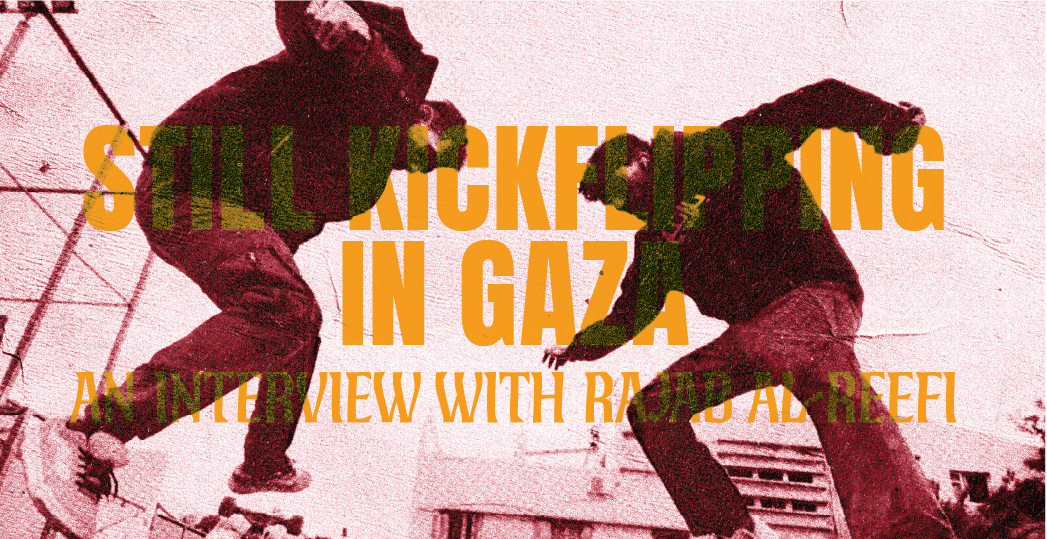

An Interview with Rajab Al-Reefi by Toby Brockelbank
Nexus have been working on this interview since July as, “Communicating with the outside world is extremely difficult, because electricity is unavailable, the internet is very weak, and sometimes it cuts off for days”. We are very grateful and proud to announce that we have another interview in from Gaza Skate Team, more than a year on from last year’s Kickflipping in Palestine. We also want to thank the global skate community and Palestine advocacy groups for their support getting eyes on Gaza Skate Team. When we first messaged Rajab regarding another interview, he said “Thank you for not forgetting Gaza. You’re part of our family”. Nexus implore readers to share Gaza Skate Team and support their efforts in any way you can – later in the article Rajab describes how you can donate to the crew, “For over 4 years now, we haven’t received anything related to skateboarding… We currently have only 5 skateboards, and the number of children and youth is about 60”.
When we first reached out in early July, I asked what has changed in Gaza since our last interview and how have conditions changed, “Hello my dear friend. Of course Gaza has changed in a way I cannot describe, everything in our lives has changed for the worse… Conditions have changed for me and for everyone living in this prison, because the war of genocide has not stopped, the risks have increased and the challenges have multiplied… we are dying a slow death here”. Rajab further described how, “Over the past year, conditions in Gaza have deteriorated significantly. The ongoing war has deepened people’s suffering, and daily life has become much harder. On a personal level, we, as Skate Gaza Team, have been heavily affected. We lost most of our skateboarding equipment — either to airstrikes or repeated displacement. We became unable to organize the activities we used to provide for the children, and that has been incredibly painful for us. The children we supported are suffering more than ever. The war has intensified their fear and anxiety, and losing skateboarding activities has taken away their only escape. They ask us every day: ‘When will we play?’ — and we don’t know what to answer. Despite all this, we haven’t lost hope. We are constantly looking for new ways to support the children, even with simple means. But the truth is, we are in desperate need of help to restore the activities that gave the children moments of real joy.”
I followed this by asking what is causing the most anxiety for the children of Gaza, “The ongoing war and sudden attacks. This causes great anxiety for the children, because they are exposed to danger and death at any moment”. I also asked how the lack of skateboards is affecting Rajab, “Before the war, I used to skate every day. The skateboard was part of me – my daily escape to release my energy and clear my mind. I used to train with the kids, learn new tricks, and feel free on those four wheels. Today, I don’t even have a board of my own. Most of our boards were destroyed, and some were lost during displacement. I haven’t skated for months now, and that hurts more than I can put into words. Skateboarding was never just a sport to me. It was therapy. It was a way to escape the pressure of daily life. Losing it has made me feel like a part of me is missing. But despite that, I still feel like a skater at heart. I still plan the tricks I’ll do when the boards come back. And I still believe that I will stand on a board again, and teach the kids just like I used to. Skateboarding has stopped in Gaza, but my love for skateboarding has never stopped.”
When we spoke to Rajab again in late September, he fortunately shared how, “I managed to return to skating and giving lessons to support the children — but after very great challenges, and after searching for our equipment that was buried under destroyed homes. This was extremely dangerous, but we had no other choice. We made the decision to search after a 4-month pause from skateboarding”. Following the news, I asked Rajab what tricks he had planned, “Honestly, right now I am trying to find a suitable place — even a simple one — to practice, so I can learn better”.
Rajab shared what daily life is like in Gaza, “Of course daily life is hard — extremely hard. I live in Al-Tuffah neighbourhood, which has now become a border area. The yellow line has moved closer and is now only about 100 to 150 meters from my home. Every day there is gunfire and bombs, and sometimes we are forced to leave our home, then return after a day or two. This is how our difficult daily life continues”. Rajab later shared he has been displaced there with his wive and two children. The Al-Tuffah neighbourhood is in eastern Gaza City and the yellow line splits Gaza with more than half of its area under direct Israeli military control, meaning Palestinians cannot enter or live in most of Gaza. As reported by UN News on the 12th of September, Israeli forces have been gradually pushing the line inwards and displacing families near the yellow line. The yellow line, which is being continuously violated, was put in place after October 2025’s ceasefire agreement. Rajab wanted to stress, “The problem is that many people in the world believe Gaza is under a ceasefire, but the opposite is completely true.”
The 5th of August marked the tragic one-year anniversary of skater Raed’s death in Gaza. Rajab told us what had happened, “Raed was with us at a recreational activity at the YMCA. He told me that after work he would go to the place where trucks carrying humanitarian aid enter and try to get a bag of flour for his family, because we were in an indescribable famine. Sadly, he went and came back a martyr. We should note that Raed had already lost his father in this war.”
I asked Rajab how we can help the people of Gaza, “I ask you to truly stop the war”. Discussing international support Rajab answered that, “Support has decreased significantly right now, and the problem is that we need more and more support now more than ever”. I also asked if occupation had intensified and supplies were harder to get, “Yes, absolutely. For over 4 years, nothing related to skateboarding has entered, due to the suffocating siege imposed by the Israeli occupation.”
Answering how we can get skateboards and equipment into Gaza, “Right now, the strongest coordination with the Israeli occupation to bring in humanitarian aid and other supplies is through international organisations like the Red Cross, Doctors Without Borders, the United Nations, Save the Children, and other international organisations. These organisations can easily bring in skateboarding equipment, because skateboarding equipment poses no danger and is no less important than medical or humanitarian aid.”
I asked if the number of Gazan skaters has grown, “The number has not increased as needed, because skateboards are not available. We currently have only 5 skateboards, and the number of children and youth is about 60 — all of them skating on 5 boards. This is unbelievable. Whether the number increases or decreases depends on whether we can get skateboarding equipment”. “We have suffered greatly from a lack of skateboarding equipment even before the war, and to this moment nothing related to skateboarding has entered. For over 4 years now, we haven’t received anything related to skateboarding.”
Rajab spoke on the other groups running recreational activities in Gaza, “We used to carry out several training activities for children in various places where displaced people gather. But after we lost our equipment, we now work in one place — the YMCA — which has become a place for displaced families who lost their homes. Our activity there includes more than 60 children.”
After seeing Gaza Skate Team’s flying kites on their Instagram, Rajab explained that this occurred “after we were threatened with death if we flew kites. This is something we love very much in Gaza, but after Israeli threats, we were banned from it, and all of Gaza’s children are sad because they are prevented from flying kites.”
Is there any way we can donate to Gaza Skate Team? “We had a fundraising campaign, and it was closed because the name ‘Gaza’ was in the campaign — this is one of the challenges we face. But our friends at Skate Pal help us by using their PayPal account. However, the donor must write in the notes during the transfer that the amount is a donation for Skate Gaza Team. Additionally, we work with an exchange office here in Gaza, and we can also receive any donation through PayPal in the same way.”
Lastly, Rajab shared his final words for readers, “To everyone who read our story, to everyone who saw our photos, to everyone who heard the voices of our children: I want you to know that Gaza is not only war and destruction. Gaza is children who dream, youth who create life from the rubble, and families who hold on to hope despite everything. We at Skate Gaza Team create joy from nothing. We search for boards under the rubble, repair what can be repaired, and build ramps from wood. We have not stopped, and we will not stop. But we cannot do this alone. We need you. We need you to hear our voice, share our story, and support our children in any way you can. Do not forget Gaza. Do not forget its children. And do not let the world forget them. We are here, and we will stay here. We dream, we play, and we make hope. Because Gaza’s children deserve life, they deserve to play, and they deserve to dream. Thank you. From Gaza, with all our love.”