

By Andrew Lin.
Nexus got a nerd to get an Official Information Act request on enrolment demographics here at UoW. Wanna see if engineering really is a sausage fest (it is) and which stereotypes our cohort might defy (a few)? Curious how 7 subjects could make up almost half of our enrolment? Read below and thank Andrew Lin (also maybe help him get an analyst job)
The OIA…
Now, that might sound like a drug name, and… fair enough.
But a student, you’ve probably heard some stereotypes; e.g STEM is a sausage party, universities swarm with international students, and Waikato is some crazy combination of law, business, and STEM enjoyers. I had heard so many of these that I decided, let’s get some OIA enrolment data (the Official Information Act lets anyone request government information, and they must respond as fast as possible); I also love a good Stats NZ breakdown or election polling! So now we can properly look at these questions, rather than just vibes. E.g. engineering degrees might exist just as much because it’s profitable for the university as because every student apparently dreams about money, beams, code, and electronics in their sleep. So whether or not you asked for it, let’s look at numbers!
I used fyi.org.nz to request 2025 University of Waikato enrolment data, by ethnicity, age band, gender, domestic vs international student, and residence region.
Note that not all subjects are included and that numbers represent subject enrolments rather than students.
Take all insights with a grain of salt. For example, fields with fewer than 5 individuals are shown as <5 rather than specific numbers for privacy, which affects the percentages.
THE DETAILS
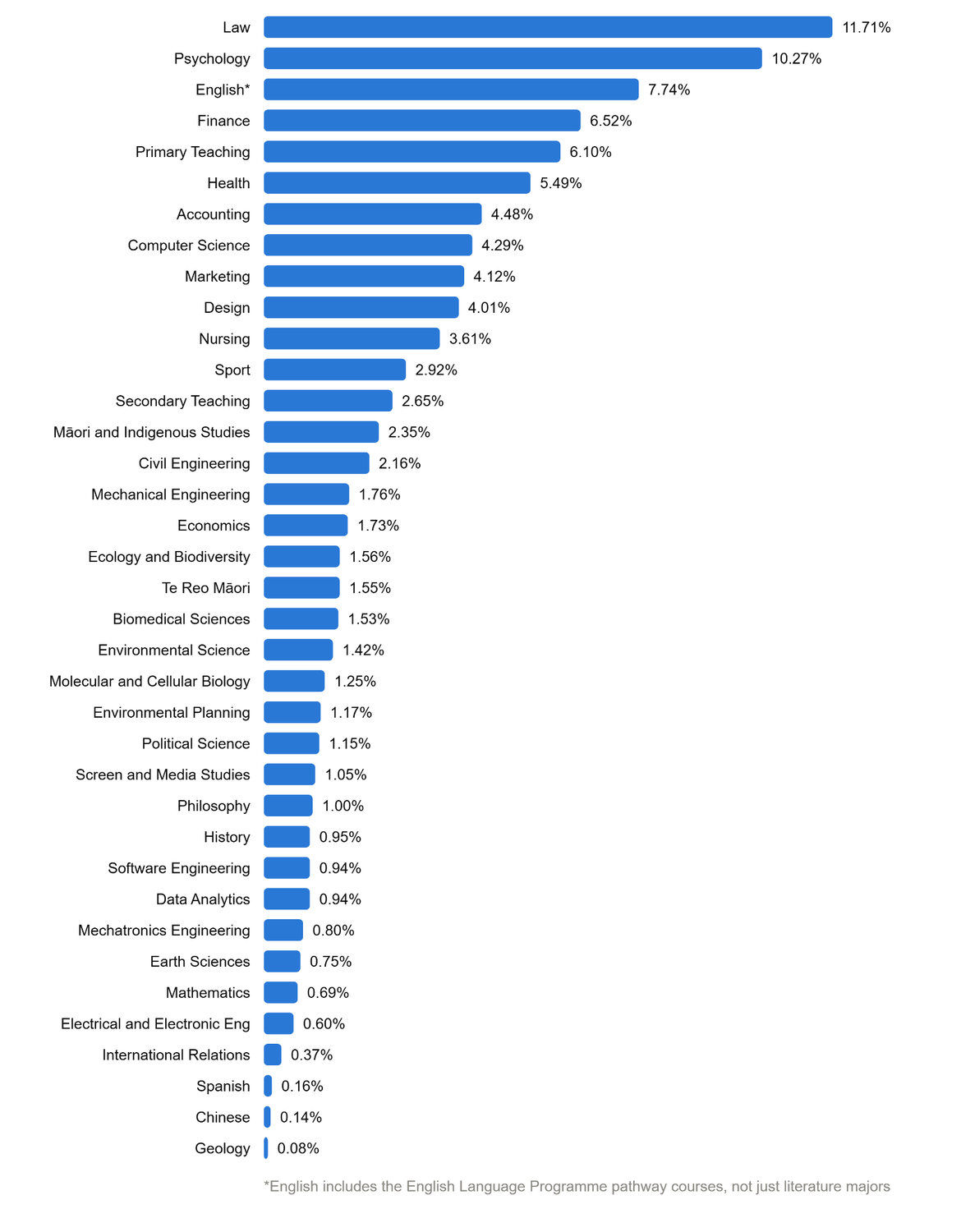
No doubt you might assume Waikato has strengths and weaknesses; we are, after all, not Otago and Auckland with their fancy generalism and medicine schools, nor Vic and its humanities/law and proximity to Parliament.
Indeed, a regional university reputed for vocational education and areas such as STEM, Business, Law, Teaching, Nursing, Māori Studies, is in fact dominated by those areas.
Law and Psychology at ~11% each (turns out Suits and MBTI aren’t exactly in the job description), Finance and Primary Teaching at ~6%, Health, Accounting and Computer Science at 5.5%, 4.5%, and 4%, combined, equal nearly half of all enrolments!
Te reo Māori and Māori/Indigenous Studies combined equal ~4%, which makes sense given the university’s relationship with local iwi Waikato-Tainui.
Within Engineering, Civil and Mechanical lead at around 2% each, with a gap down to Software, and poor old Mechatronics and Electrical/Electronics following behind – overall chunky, as per the university’s marketing (we’ll get onto the university’s motive soon).
The social sciences stay small: Political Science and International Relations at 1.15% and 0.4%, History and Philosophy at 1%; languages also struggle, with Spanish and Chinese at ~0.15% each (bet you didn’t know Korean is also taught at Waikato).
For a university that loves talking about the environment (looking at you Bachelor of Climate Change), Geology barely hits 0.1%, while its more spotlighted cousins Environmental Planning, Environmental Science and Earth Sciences all hit near 1% or more.
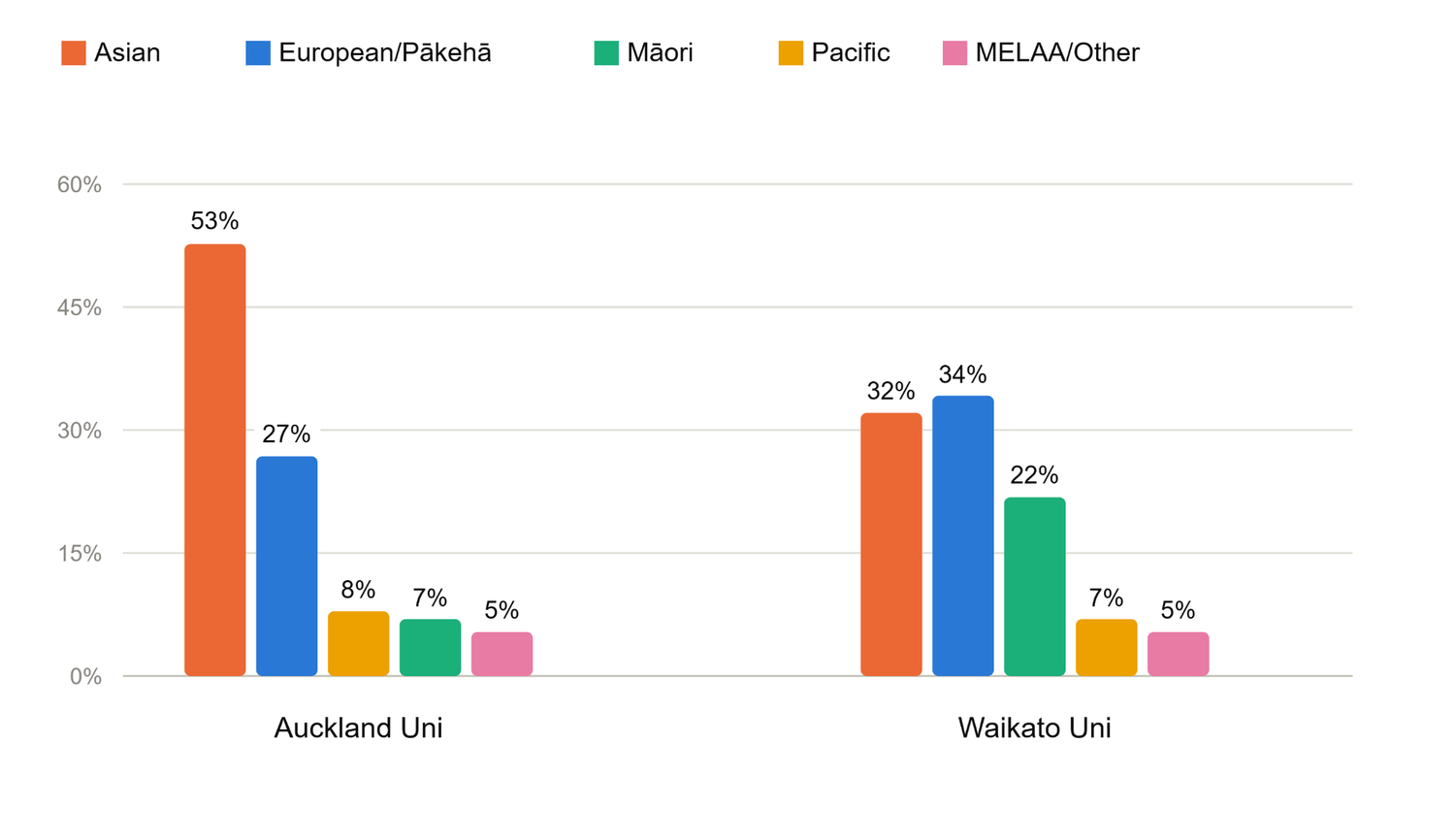
You might know Auckland University as Asia 2.0 since ~53% of students are Asian, and given stereotypes about demographics (e.g Waikato mainly White and Māori), it makes sense to look at ethnicity.
Well, what if I told you we (domestic plus international) are ~30% Asian! European hits 34%, Māori and Pasifika pull in 22% and 7%.
First I was shocked, given the national 50%+ European, 20% Asian, and 20% Māori figures you might also have in your head; then I was like, this makes sense; e.g Asian international students, regional Māori population, targeted marketing for certain groups.
Most courses deviate from baseline, with Te Reo Māori and Māori/Indigenous Studies being obvious exceptions, and Design an outlier at nearly 70% Asian.
On STEM, Computer Science and Software Engineering are standouts (Asian ~50%, European ~30% and Māori 13/8%), whereas Environmental Sciences, Ecology/Biodiversity, and Earth Sciences are more European (tramping stereotypes galore), compared to somewhat more balanced programmes such as Mechanical and Civil Engineering.
Business subjects such as Accounting, Finance, and Economics also skew more Asian than others (unfortunately for the Asian parents, doing Economics may not magically result in getting $1 million yearly).
Many social sciences (History, Law, Psychology) run low on Asian enrolment but higher than average for Māori (except some like International Relations) – the opposite of STEM, which tracks with a “humanities/arts skew Māori, STEM skews Asian” stereotype, at least superficially.
Law, as an example, has a more balanced mix: Asian 17%, European 35%, Māori and Pasifika 29% and 13%.
GENDER
No surprises based on what I’ve seen myself:
Computer Science, Mechanical/Mechatronics/Civil Engineering, and even Economics have majority male enrolments; Law, Psychology, Political Science, and Environmental Planning run 70%, 80%, 60%, and 70% female, potentially reflecting representation, career, and cultural expectations for both genders. Biomedical Sciences, Ecology/Biodiversity and Molecular/Cellular Biology also have above-average female enrolments.
However, a few subjects, Finance, Sport, Screen and Media Studies, etc, sit near 50/50, which is the theoretical biological sex ratio.
AGE
Most subjects skew toward under-20s and the 20-24 band, followed by 25-29ers, tracking with most students starting from school or taking gap years (yet we still seem to have a subpar dating app pool…).
However, subjects tied to returning to study or career changes (e.g. Health, Law, Secondary Teaching) skew noticeably older, while, for example, Software Engineering and Marketing mostly concentrate on freshers – perhaps straight-to-job pathways?
Region and International/Domestic Status
Ever wondered if Hamiltonians are fleeing for Palmy or Auckland?
I can’t give you the whole answer, but here are those who tolerate Hamilton enough to stay.
Congrats to the Jaffa-enjoying Aucklanders who’ve made their way to the mighty Waikato – you hit 13%.
Be worried you’re outnumbered by the 46% from Waikato, plus 18% from Bay of Plenty – no wonder half my peers seem to be from Tauranga.
Wellington, Gisborne, Northland, Hawke’s Bay, and Taranaki all sit around 2-3% each
And all 10 students from the West Coast, Otago, Nelson, Canterbury, and Southland can be friends, since they barely add up to 3%.
Plot twist: there’s a chunky Unknown region at 30% who are likely mostly international students (23% of total enrolments), plus domestic students who might be missing records, homeschooled, or for other reasons.
Most programmes (especially with local context such as Sport, Nursing, Primary, Law, Māori Studies) have strong domestic enrolments. However, subjects such as Finance, Design, and English (many ESOL) pull more strongly from international students. Postgrad programmes skew international broadly, with 41% vs just 13% at undergrad.
CONCLUSION
So what is there to learn, besides that I should have spent my evening on assignments instead of this?
Many of the stereotypes you’ve heard lean true, but there’s also nuance, such as the overall ethnicities being different to what you might have expected. Beyond satisfying an itch for curiosity about your neighbours, the OIA process can also be applied to plenty else you might give a damn about, such as ensuring government broadly remains accountable. However, given subjects such as Political Science and Philosophy at ~1%, Spanish and Chinese at ~0.15%, against seven subjects making up half of all enrolments, it is worth asking: what even is the point of university? Because I think we are forgetting that it should be something broader, rather than just vocational skills and shiny degrees and projects.
Unfortunately, I’m not the best cost-saving consultant for the university, given I am a poor student, but we probably know what the university and society prefer you to study, for good and bad… (cough, just have a look at the top subjects on the list and the new medical school)
LINKS & SOURCES
https://fyi.org.nz/request/32732-student-enrolment-data-by-subject#incoming-135762
https://fyi.org.nz/request/33148-student-enrolment-data-by-subject-followup#incoming-137712
https://www.auckland.ac.nz/en/about-us/about-the-university/equity-diversity-inclusion/university-demographic-data.html