
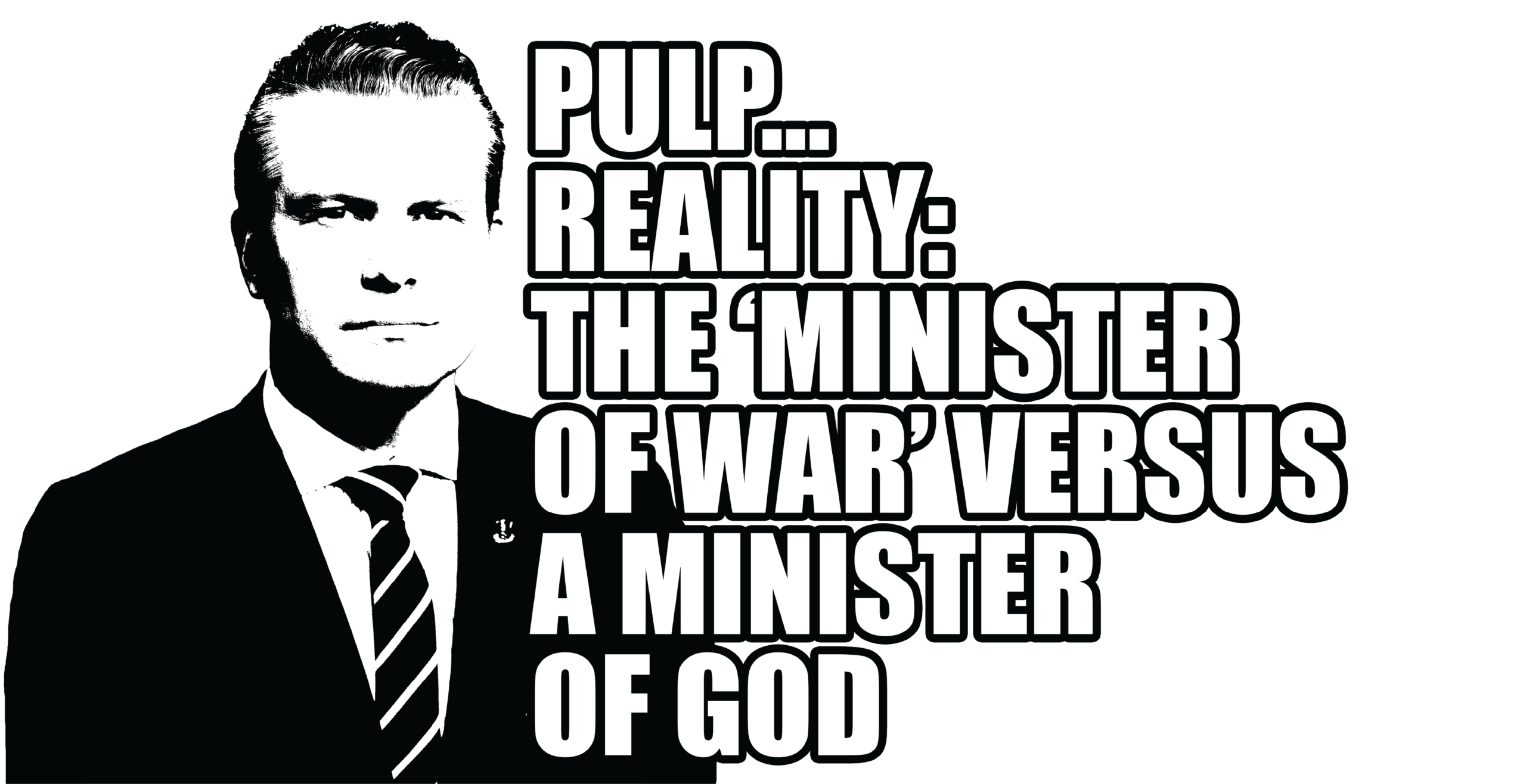

We sent Dylan to talk to Campus Chaplin and genuinely good human Brother Andew. Or at least we planned to. We were curious as to ‘Brother A’s response to Trump reposting AI generated images and Pete Hegseth quoting fake scripture from Tarantino. Dylan wisely opted out of entering a house or worship in fear of being struck down. and emailed some questions instead. And Brother Andrew just did what he does.
So, Dylan consulted our Higher Power (in that he is sometimes high but generally gives good advice) who said “Just publish what the man wrote without your stupid questions. He is smarter than all of us, print what he says. Then we can go home. Here is what he said…
ONE CHAPLIN’S RESPONSE
It has been suggested by some that I should keep politics out of the Chapel, but as Pope Leo XIV said, “The church can never be exempted from speaking the truth about humanity and the world.” I prefer to use cartoons in an attempt to spark debate rather than engage in direct confrontation.
From a New Zealand perspective, what struck me about Pete Hegseth using the “Pulp Fiction” version of Ezekiel 25:17 is not simply that it confused cinema with scripture, but that it blurred the line between faith, violence, and political power. Religious language has always been powerful in public life. If governments can frame military action as morally sacred, then foreign policy begins to feel not merely strategic, but divinely sanctioned. That should concern us all, regardless of our political persuasion.
Pete Enns recently addressed this directly on The Bible for Normal People podcast, criticising Hegseth’s use of apocalyptic language around Armageddon and the Book of Revelation. Enns argued that Revelation was never meant to be read as a geopolitical roadmap for modern conflict in the Middle East, but as symbolic literature written to encourage persecuted Christians living under the Roman Empire. He described the idea of Jesus as “a blood-lusting warrior” as deeply at odds with “Jesus, the Prince of Peace,” and warned that this kind of rhetoric risks aligning Christianity with empire and militarism rather than the Gospel.
The deeper risk when popular culture supersedes scripture is not factual confusion about a Bible verse. The real danger is that Christianity becomes shaped more by spectacle, masculinity, nationalism, and internet performance than by the person of Christ. The Bible becomes aesthetic — a prop, a vibe, a meme — rather than a text that challenges power and calls people to humility and compassion.
That also connects to the wider tensions around Donald Trump, JD Vance, and their criticisms of Pope Leo. I do not think we are witnessing a formal schism in the historical sense, but I think we are seeing the rise of a distinctly American form of Christianity where political identity increasingly outweighs theological tradition. Christianity becomes less about creed or sacrament and more about cultural allegiance and media ecosystems.
Martin Luther used pamphlets and the printing press; today, politics move through podcasts, memes, and AI-generated imagery. The technology has changed, but the deeper question remains the same: does Christianity still point beyond power, or has it become another instrument of it?