
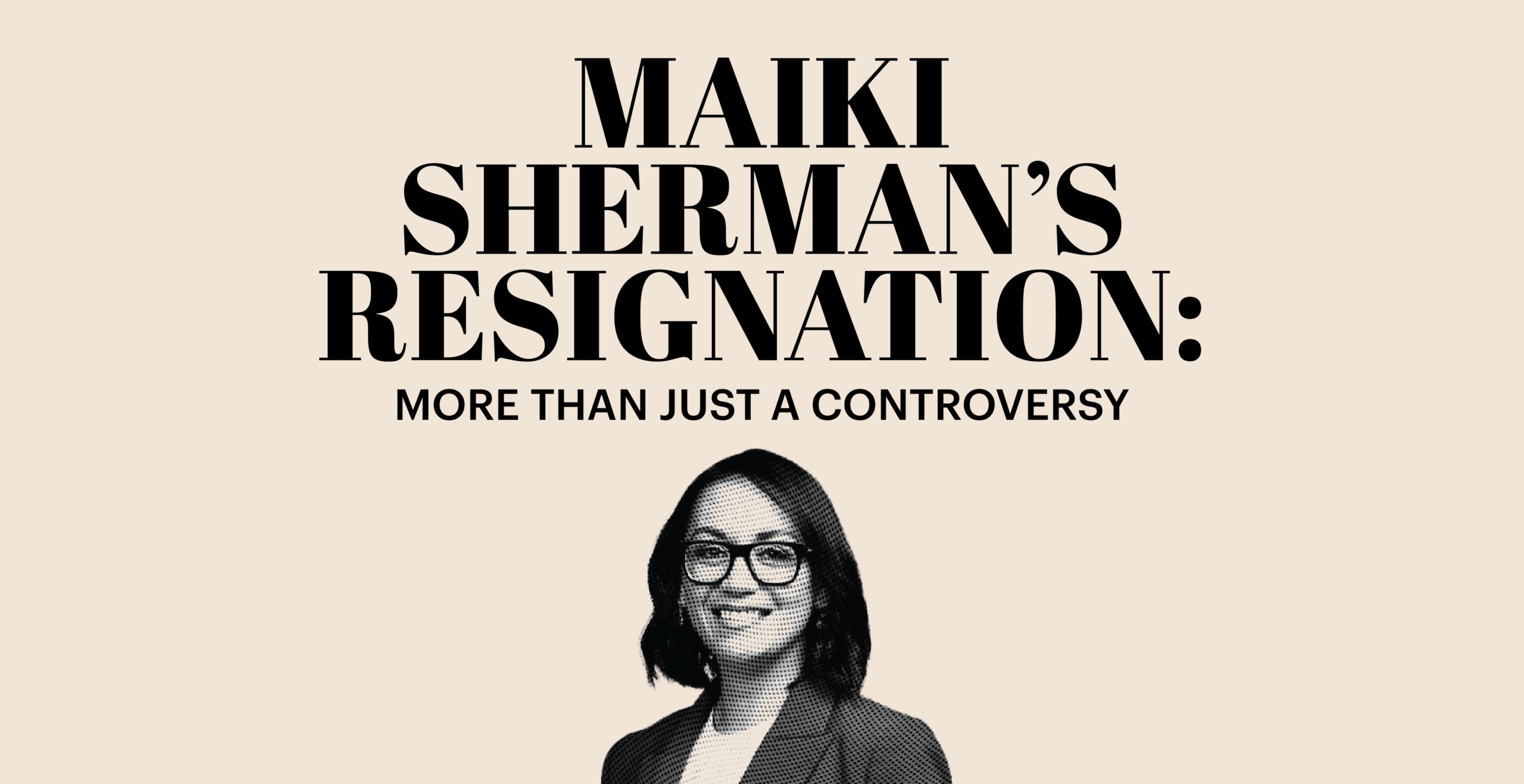

Maiki Sherman has resigned from her role as political editor for 1News at TVNZ.
That’s the headline, but it’s not the full picture. The circumstances surrounding her resignation have been only one part of an ecosystem of muddied waters that now make up the relationship between Parliament, the media, and the New Zealand public.
The journalist becomes the story
The catalyst that led to Maiki Sherman’s resignation was a Substack article written by political commentator and Free Speech Union councillor Ani O’Brien on the 28th of April, 2026. O’Brien alleges that Sherman used a homophobic slur when speaking to Stuff journalist Lloyd Burr at a pre-budget drinks hosted by Nicola Willis in May 2025.
Ten days after the allegations were published, Sherman resigned from her position, calling it “untenable”.
According to Sherman, “from my own perspective and for context, my comment was made in response to deeply personal and inappropriate remarks made to me that evening”, though she acknowledges “this does not excuse my actions”.
Well-timed controversy
It is undeniable that Sherman’s language towards Burr was inappropriate. But from the available information, it seems as though the two addressed the incident a year ago. After an apology from Sherman, Willis contacted Burr, who did not wish to pursue the matter further. Sherman’s manager was made aware of the incident at the time.
The key to any successful story is timeliness. So why would this one garner so much attention a year after it has occurred?
The allegations were published less than a week after National filed a formal complaint to TVNZ about the conduct of its staff. Sherman was alleged to have broken the rules of Parliament by “aggressively” pursuing an interview with Stuart Smith in regards to Christopher Luxon’s leadership. While Speaker of the House Gerry Brownlee acknowledged that other journalists broke the rules while reporting on the story, only Sherman was suspended. Sherman’s following controversy could not have had better – or worse – timing.
There is a point to be made about accountability in the media. Former political editor of 3 News Stephen Parker told The Spinoff that he felt “it’s not necessarily something that should be swept under the rug”.
There is also a point to be made about the magnitude of consequences Sherman faced.
Former political editor for Newshub Duncan Garner wrote that he was “genuinely disappointed by what’s happened to Maiki Sherman”.
“The rules were broken all the time. By MPs. By ministers. By people who later got promoted, protected, forgiven, knighted, and sent off to cushy jobs. So why Maiki?”
Politicians vs the media
Ani O’Brien may have catalysed the reaction that led to Maiki Sherman’s resignation, but she was not the sole cause. It is true that the role of political editor at TVNZ is a public-facing position, and there are public-facing responsibilities that come along with that. It is also true that for months leading up to Sherman’s resignation, the current government was butting heads with the media more than ever – not just TVNZ.
Between the allegations against Sherman and her resignation, David Seymour spoke publicly against John Campbell’s appointment as host of The Morning Report due to opinion pieces criticising the coalition that Campbell had written in the past. Without naming RNZ chief executive Paul Thompson, he said in an interview that he suspects Thompson “won’t be answering the call at RNZ for much longer.”
Seymour denied breaking the law by using his power as a minister to give instructions to a state broadcaster.
This brought forward the announcement of Thompson’s resignation, with RNZ Chair Jim Mather calling Seymour’s commentary “unhelpful” and clarifying that the decision to resign was made by Thompson alone.
Last year, Winston Peters alluded to cutting RNZ’s funding in an interview, telling then host of The Morning Report Corin Dann “The fact is, you’re paid for by the taxpayer and sooner or later we’re going to cut that water off too”.
What now?
A lot has been lost in this controversy. First of all, we’ve lost a great journalist. On the 22nd of May, less than two weeks after her resignation, Maiki Sherman won Best Political Journalist of the year.
Judges described her storytelling as “exemplary, bringing impact and on-the-ground reality to a powerful political story”.
In her acceptance speech, she maintained that she was fair in her reporting.
“I won this award for my coverage of Te Pāti Māori last year. I am courageous, and I am fearless when it comes to holding politicians to account, but that’s across the board”.
She also said that the controversy had been “a difficult time” for her.
“A part of me was nervous to come tonight, but an even bigger part of me was determined to come tonight to stare this situation in the face.”
While there is hope in the national recognition of Sherman’s journalism, the consequences of her resignation are far from over.
1News is a major news provider for many New Zealanders, and questions have been sparked over the future of Māori representation at TVNZ.
Furthermore, Paddy Gower expressed concern over the lack of support Sherman received from TVNZ. He told The Spinoff that “the golden rule” for any news organisation is to “always back your political editor”. Former 1News political editor Mark Sainsbury agreed, saying not backing Sherman could have “a chilling effect on the rest of the staff”.
The pieces left behind after Sherman’s resignation are not to be picked up lightly. TVNZ has lost an award-winning political editor in this string of controversy. Our political journalists have lost the certainty that their companies will back them. But perhaps the most wide-spread loss of all is our nation’s trust in the media.