
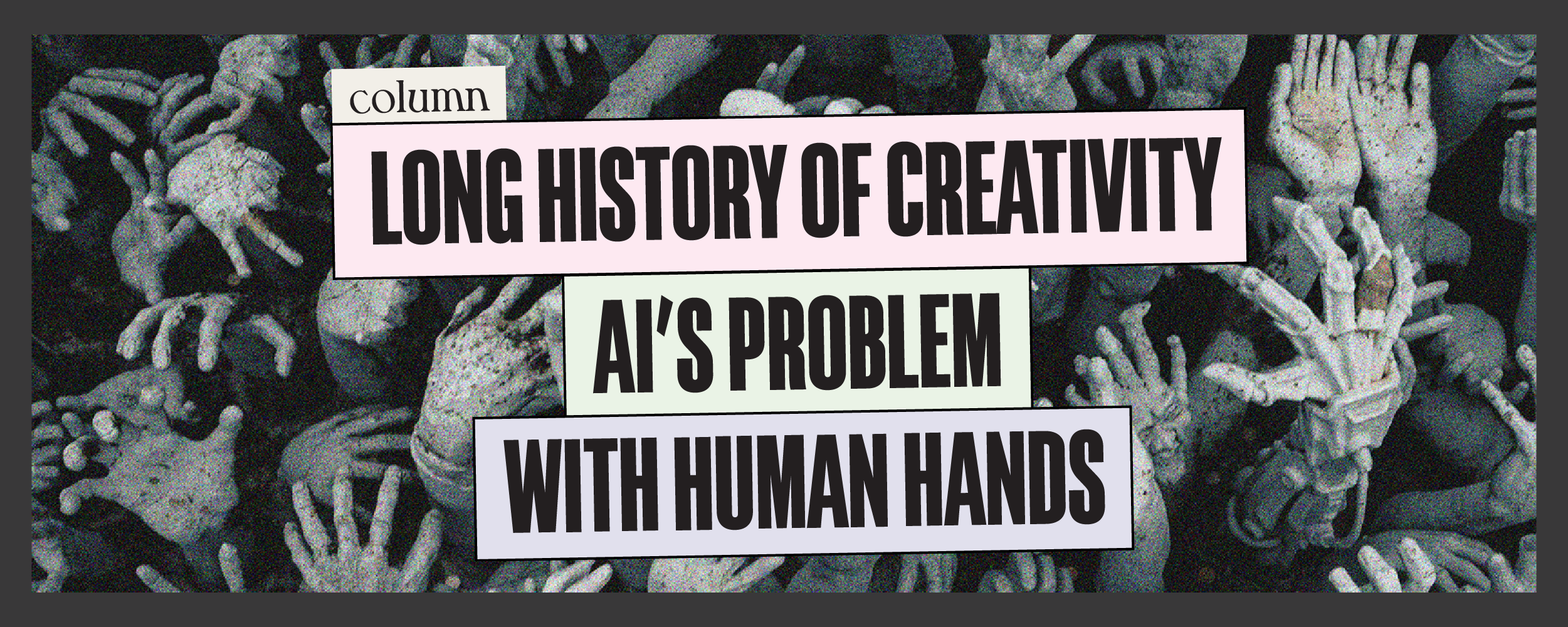

It’s almost pyrrhic that Artificial Intelligence struggles to replicate the way hands look, when some of the first pieces of evidence regarding human creativity are handprints branded on the walls of caves. Located in Indonesia are what is believed to be the oldest known handprint stencils, dated around 67,800 years ago. The artist pressed their hand against the limestone wall of the cave and blew a mouthful of pigment over it, after which they are thought to have artistically elongated the shape of their fingers in the negative image (which Professor Adam Brumm describes as “a very us thing to do.”)
Art survives as a relic of us (I use ‘relic’ not ‘artifact’ because here we examine art as part of a larger cultural picture.) Not only through the subject matter but also the materials and technology we had access to, along with the physical medium. Art is so many things, and AI will never replicate creation because it requires a part of ourselves. It reflects the artist, the time in which they lived and the ideas that were important enough that (consciously or unconsciously) become immortalised in their work. This is exemplified by the conceptual art project (1988-2021) by Japanese artist Yukinori Yanagi; ‘Wandering Position.’ Yanagi created multiple intricate pieces by tracing the path of an ant with red chalk, grease pencil or wax crayon inside a bordered area. The true beauty of the artwork are the ideas that we apply to it. It’s what it represents, the labour of the artist and the role of the subject. It’s something that AI will never be able to re-create because the core of the art is its utter humanity whereas AI is characterised by an uncanny vacuity. Emotion is often central to the creative process. Tchaikovsky wrote the Nutcracker after the death of his sister. Even to this day that art is continually recreated and it lives on in the most unique forms, such as ballerina Autumn Klein’s process artwork where she dances with paint on her pointe shoes across a canvas, so each movement becomes its own imprint in the visual representation of the well-trodden choreography.
One of the arguments I see a lot is that AI makes art more accessible. I believe that is a fundamental failure of imagination. Emily Kilby, paralysed at age 13 by a SCI, paints with a brush using her mouth. Her canvas of choice is pottery thrown for her by her sister, Olivia, each finished piece a stunning labour of love with whale sharks swimming across the surface of handmade vases and flowers blooming on glazed ceramics. Beethoven continued to compose symphonies long after he lost the ability to hear. Human creativity is hard to suppress.
In the case of human hands, AI relies on a hollow, 2d rendering of callow statistics. The god from the machine does not understand organic form and how the joints bend or how skin is shaped around the skeleton. It has no concept of the uncanny valley effect (no natural instinct to when someone looks sick or hurt or wrong.) It sees us as the homunculus, a funhouse-mirror six-fingered suggestion. AI is a thrall to human creativity, it relies on us, as creators, to continually feed it. True art is a call and response (not simply an echo), it’s people loving an idea or an image enough to devote time to its repetition. The essential problem of AI art is that the algorithm will never be able to communicate anything more meaningful than ones and zeros.