
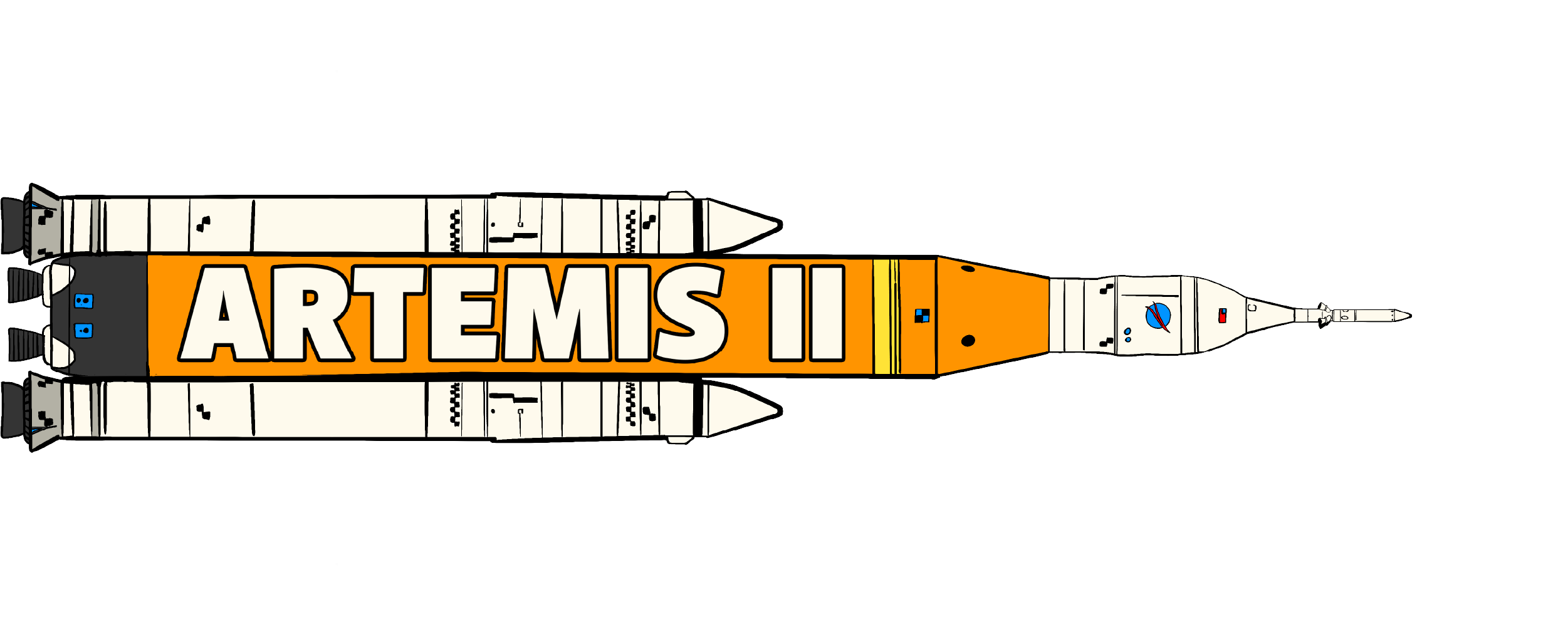

Copy moon joy. On the 1st of April, 2026 the Artemis ii mission commenced, launching spacecraft Orion from Kennedy space centre in Florida. Significant in many ways, this
was the first crewed flight to the moon in over 50 years, (the last being the Apollo 17 in
1972), as well as this being the farthest distance human being have ever travelled from
earth. The mission lasted until April 11th, which was how long it took to orbit the moon
and then safely re-enter the earth’s atmosphere.
The Artemis missions were supported by a very qualified staff down at Houston Ground
Control but aboard the spacecraft were: Commander Reid Wiseman, Pilot Victor Glover, Mission Specialist Jeremy Hansen, and potentially the most impressive of all, Mission Specialist Christina Koch. While there’s been a lot of noise around DEI and diversity quotas, Koch holds the record for the longest single spaceflight by a woman 328 days on the ISS. This number is even more significant when compared to her three companions, whose total combined number of days in space equals around 330. She participated in the first all-female spacewalk in 2018 and holds degrees in electrical engineering and physics.
Not only was the Artemis mission a triumph for space exploration and science, but it
was also a triumph for humanity too, as the whole world watched their journey, there
are a few key moments we can pick out as significant.
Aboard the spacecraft they carried a piece of the Challenger (a rocket that exploded
after launch, killing its crew), hardware from the Columbia (that exploded upon re-entry
to Earth’s atmosphere) and a 1×1 inch piece of canvas from the Wright Brothers original
plane. From Ground Control, at one point, Jenni Gibbons could be heard quoting the movie Project Hail Mary “amaze, amaze, amaze.” The team even named a crater ‘Caroll’ after Wiseman’s deceased wife. One notable instance was on April 6th the crew was woken by the voice of Jim Lovell (astronaut aboard the Apollo 13) delivering the posthumous message “welcome to my old neighbourhood.”
There are arguments that the current push in space travel, specifically within the USA,
is a propaganda campaign designed to strengthen the image of America but those who
argue that the lunar missions represent a positive trend for the future of everyone and represent a brand of scientific achievement that calls back to a global need for science that is accessible to all, that all can share in the benefits of and that is for the collective good. Potentially, nothing is a better example of this than the crew of the Artemis ii mission, looking back at us from beyond the moon.
Christina Koch is quoted as saying: “Houston, we have you the same, and it is so great
to hear from Earth again. To Asia, Africa and Oceana, we are looking back at you, we hear you can look up and see the moon right now. We see you too. When we burned this burn towards the moon, I said that we do not leave Earth, but that we choose it. And that is true. We will explore, we will build. We will build ships; we will visit again. We will construct science outposts, we will drive rovers, we will do radio astronomy. We will found companies, we will bolster industry, we will inspire. But ultimately, we will always choose Earth, we will always choose each other.” And Ground Control responded, “Integrity, from Earth, our single system, fragile and interconnected, we copy. Those of us that can, are looking back.”
Glover, in an Easter Sunday interview said, “You guys are talking to us because we’re in a
spaceship really far from Earth, but you’re on a spaceship called Earth that was created
to give us a place to live in the universe,” Glover continued. “Maybe the distance we are
from you makes you think what we’re doing is special, but we’re the same distance from
you. And I’m trying to tell you — just trust me — you are special.”
Notably, on this mission, it was seen as important that the crew be trained in photography in addition to all the rigorous training that accompanies a spaceflight. It was felt that not only was it important to test the SLS and the landing craft but it was also important to document their personal experience of space for the general public to see, to share, to experience. The future of space travel is bright with the goals set by the Artemis mission series, as explained by NASA: “Under Artemis, NASA will send astronauts on increasingly difficult missions to explore more of the Moon for scientific discovery, economic benefits, and to build on our foundation for the first crewed missions to Mars.