
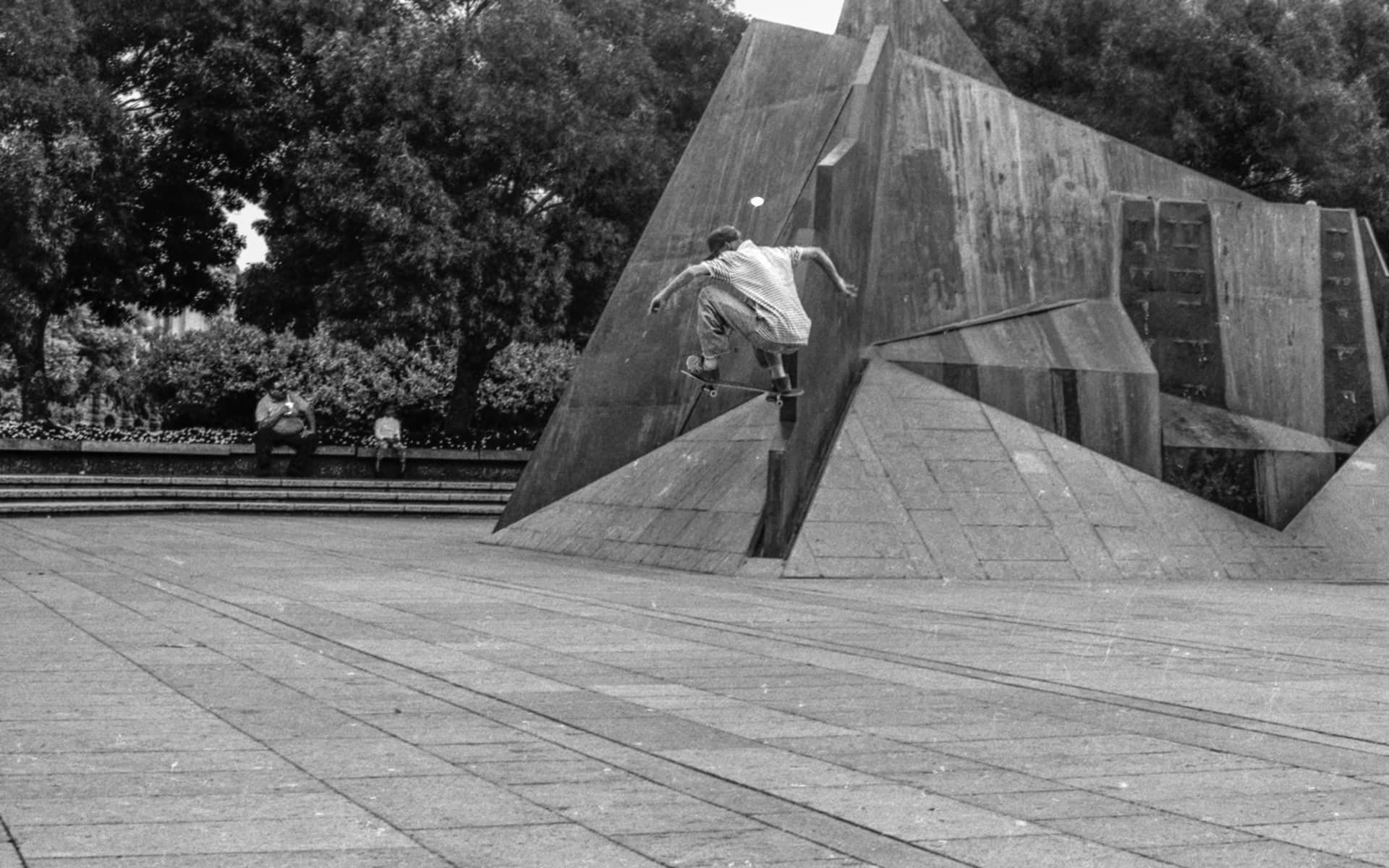

Levi Hawken skating Aotea Square in the 1990s. Photo: Stjohn Milgrew (Wilton 2017)
To skateboarders, where we skate matters. AI will harm our connection to the places we skate. This may seem like a small concern in the scheme of things, but that might be the point. Maybe you don’t care about skateboarders, but something as specific as this shows us just how all-consuming AI’s effects are. Photos and videos have long been how skaters share knowledge of where we skate, and build meaning around those places, or ‘spots’ as we call them. Globalisation has eased skaters’ access to spots, both thanks to global communication and modern travel. But skate video itself is where AI creeps in, with AI-generated videos circulating non-places. We can’t skate a spot in an AI-generated video because slop doesn’t ‘exist’ in any real sense of the word.
Skaters obviously need cement to roll on, but what do the places we skate mean to skateboarders? Skaters’ second favourite thing to do is talking about skateboarding, and within the last 30 years, we have started doing this at universities all around the world. The Godfather of Skate Studies, Iain Borden, inverted this question in Skateboarding and the City (Borden 2019). Borden discussed the “production of space” (Borden 2019, 178) to answer that skateboarders are a performed critique of the places we roll and that in using our bodies, we recreate the city itself and challenge its politics (Borden 2019, 172-221). What matters to us is that skate studies started in architecture and urban planning (we are ‘street skaters’ after all) and that skaters affect the culture and use of the spots we skate. More recently, Paul O’Connor has written about the “Skate Gods” (O’Connor 2020, 67) in his book, Skateboarding and Religion. He considers our reverence of spots to be “sacred places” where we enact “secular pilgrimage” (O’Connor 2018, 1651). O’Connor writes how “Media is shown to be instrumental in making and communicating the importance of skateboarding ‘spots’” (O’Connor 2018, 1651), but more on that later. So, skate spots have iconic meaning to skaters, so much so that these places are sacred, and we pilgrimage to skate these spots. This left me asking, are there any places in Aotearoa sanctified and seen as worthy of pilgrimage?
Auckland’s Aotea Square is the “Mecca” (O’Connor 2020, 52) of street skating in Aotearoa. Chey Ataria, a renowned kiwi skater and owner of local skate brand DEF, named “Auckland old Aotea” as one of the best NZ skate spots when I was lucky enough to interview him last year (Brockelbank 2025). Another infamous kiwi skater, Levi Hawken, spoke to RNZ about Aotea Square. You might know him as the nek minute guy, with 8.3 million views on YouTube, but in the skate community, he’s known for the skill and style he brings to Auckland’s hills. Levi spoke on the Aotea Square monument (pictured) being moved, “That’s now at the top of Parnell. I had a priest telling me off last time I was there, which I kind of took offence to… It doesn’t belong to the church, it belongs to the people - but mostly to the skaters” (Wilton 2017). The artist has said the monument is to nature, but perhaps through the act of skating, the fountain has been “reproduced” as, and “transformed” (Borden 2019, 172-193), making the Aotea Square monument sacred to skaters. Aotea Square has monumental significance to the skate scene of Aotearoa.
People who don’t skate couldn’t ‘spot’ these spots, so how do skaters know them? D’Orazio, among other scholars, says it is through media (D’Orazio 2020). D’Orazio states that skate videos are “the primary medium with which skateboarders create subcultural capital”, with subcultural capital being what we know about skateboarding, such as spots. To skaters watching videos of professionals, seeing very high-level tricks performed at the same specific places elevates these spots to a mythical status. Skate videos were originally physical media. Seen advertised in magazines and heard of by word of mouth before being purchased from stores and ordered from magazines, then being shared between friends. This is where the positive effects of a recent cultural and technological shift come in. Globalisation can be seen not just as an ease of travel, but also increased access to global communication. The internet allowed skate videos to be distributed much quicker and further, and social media quickly became central with YouTube hosting hours upon hours of skate video. Social media has allowed videos to be shared via link rather than postage, and as “the vast majority of skate videos have featured urban landscapes”, the videos also share the places in them. Social media has allowed these sacred places to be shared more than ever while global travel has eased pilgrimage to them.
But if these skate videos do not feature real ‘places’ then they will not build on the mythos of skating, in fact, they may actually harm it. D’Orazio writes, “skate videos were key for the creation of authenticity”(D’Orazio 2020, 55). We could always assume that skate videos were ‘pointing’ to a real place, but AI points to nothing but an eye-melting lacquer. AI-generated skate videos have increasingly intruded on my feed. They wear a slick and shiny surface but hold nothing except an empty gimmick. Social media allowing us to share spots and travel allowing us to skate them, means nothing if we share non-places that cannot be travelled to and skated. “The most celebrated piece of skateboarding subculture” (D’Orazio 2020, 68) is being desecrated.
My argument against AI is not environmental or psychological, but about the importance of real places to the counterculture and the meaning skaters carve into spots. Recent innovations have helped share skate culture and access to its sacred places, but AI-generated video threatens to nullify the benefits of globalisation. Beyond that, AI is challenging the medium of skate video itself, which could be seen as the holy text of skateboarding. There will always be a place for ‘human-generated’ skate video, but we as the audience and as creators decide the size and sanctity of that place. So go grab a fisheye lens, and open Premiere Pro, so that the next generation of skaters can grow up knowing the significance of places like Aotea Square. If you don’t skate, go make your art. Make imperfect art. Make human art.
REFERENCES
Borden, Iain. 2019. Skateboarding and the city: A complete history. Bloomsbury Publishing. https://doi.org/10.5040/9781474208420
Brockelbank, Toby. 2025. “The ABC’s of the Aotearoa Skate Industry: Chey Ataria.” Nexus, 24-25. https://online.fliphtml5.com/ukcwj/lddv/#p=24
D’Orazio, Dax. 2020. “The skate video revolution: How promotional film changed skateboarding subculture.” The International Journal of Sport and Society 11 (3): 55. https://doi.org/10.18848/2152-7857/CGP
O’Connor, Paul. 2020. Skateboarding and religion. Springer. https://doi.org/10.1007/978-3-030-24857-4
O’Connor, Paul. 2018. “Handrails, steps and curbs: sacred places and secular pilgrimage in skateboarding.” Sport in Society 21 (11): 1651-1668. https://doi.org/10.1080/17430437.2017.1390567
Wilton, Perry. 2017. How Auckland’s changed through the eyes of skateboarder Levi Hawken. The Wireless. Accessed 8/6/2026. https://www.rnz.co.nz/news/the-wireless/374707/how-auckland-s-changed-through-the-eyes-of-skateboarder-levi-hawken