
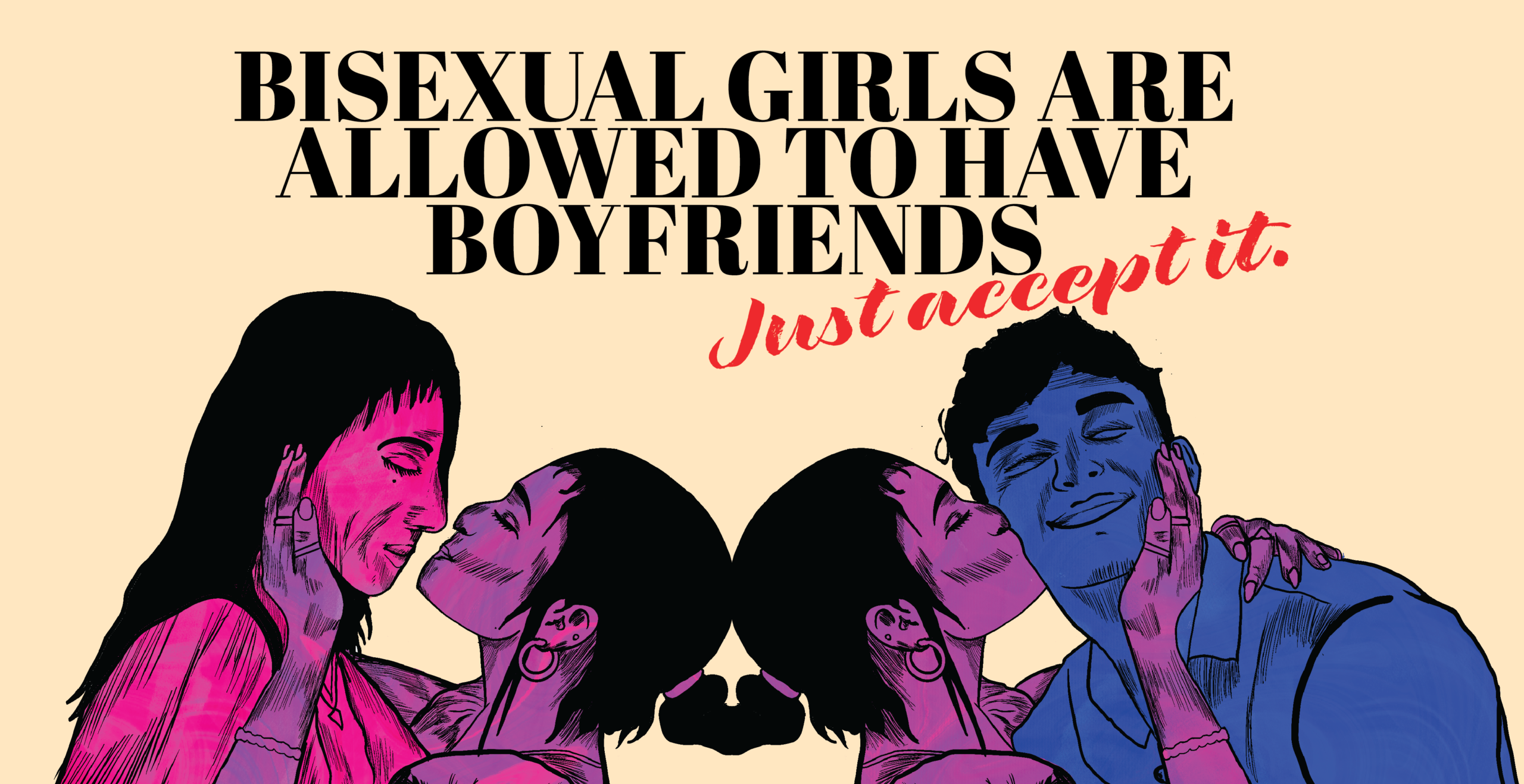

Since pride month has finally ended, it’s appropriate to talk about what’s happening to bisexual women in queer internet spaces at the moment. Since the 1980s, there has been an observable rift between bisexual women that date men and lesbians, which has been recently revived on social media. I sat down with Sonja Ellis, a professor of gender and sexualities here at Waikato University to discuss the causes of this, and what she thinks we can do to finally put an end to the drama.
- Why do you think there’s such a divide between bisexual women and lesbians?
There is a long history of tensions between lesbians and bisexual women. This tension was especially prevalent in the 1970s and 80s when lesbianism was heavily marginalised due to high levels of homophobia and systemic heteronormativity. In these days it took a lot to stand up and claim a lesbian identity and in a heavily (binary) gender divided society bisexual women were often seen as “selling-out”. Bisexual women were stereotyped as “fence-sitters” trying to “get the best of both worlds” by benefitting from their connections with men (so complicit in the marginalisation of lesbians) or were seen as lesbians who were too weak to stand up and be counted (so clinging onto connections with men to avoid stigma). A large part of this is a legacy of second-wave feminism and what it meant to stand by your feminist principles in a world where women were oppressed in society.
2. Where do you think the new resurgence of these tensions has come from?
While I think the current resurgence of tensions is partly premised on, a changing world in which “sexual fluidity” (and also increasing gender fluidity) is prevalent has made being lesbian harder. Most women who identify as lesbian prefer – and often feel more comfortable in – women-centred or women-dominated environments. Unlike the lesbian separatist subculture of the 70s and 80s this is not that we don’t ever want to connect with men but it is not where we feel most at home. We tend to gravitate towards people who share those values which most bisexual women don’t. In a society where popular culture has commodified lesbianism (e.g., popularised the “girl crush”, made it fashionable to engage in lesbian suggestible acts to attract men, or sold lesbian sex as a stop-gap until the right man comes along) it has become really hard for lesbians to meet like-minded people both socially and sexually. With commodified lesbianism so prevalent and identifying as bisexual popularised, many bisexual women have limited – if any – enduring lived experience of lesbian marginalisation. Most are or will end up in heterosexual relationships and not endure marginalisation on a daily basis like lesbians do. For lesbians, this is the point of contention. Of course, in a binary gender centric world, bisexuals experience invisibility and marginalisation also but it is different from the marginalisation that lesbians experience. So, understandably bisexual women undoubtedly get frustrated that lesbians don’t see them as marginalised.
3. Do you think social media plays a role in this divide? What kind of rhetoric are people being fed?
Social media definitely has a role to play in the resurgence and contemporary manifestations of these tensions, but as outlined above the underlying tensions have a long history that predates social media. Social media has played a role in amplifying these tensions and giving them renewed visibility. I have limited personal experience of social media so I cannot comment on what rhetoric people are being fed, but the tendency for social media generally to reward emotionally charged content and controversy undoubtedly plays a part in giving a platform to and escalating the voicing of these tensions without the opportunity for healthy dialogue.
4. Where do you think improvement can be made? How can these two groups learn to accept each other?
I think there is scope for mutual respect. Certainly, in the 1990s and 2000s these tensions were much less prevalent than they are today and had been in the 70s and 80s. While bi-erasure has continued to be an issue over the last 30 years, the rainbow community was much more cohesive through that period and identities were much less foregrounded. The focus was more on what we had in common rather than our differences. More recent trends in society, including the impact of social media and the diversification of the rainbow community, have polarised subgroups of the community and shifted the emphasis. I think there will always be tensions between lesbians and bisexual women but we can learn again to respect each other’s differences by agreeing to disagree. To do this I think we need to keep it real – too much of what we think we know is shaped by the biases of popular and social media rather than our own interaction with lesbian or bisexual women respectively.
Hearing that this is a long-term systematic issue, not one that is recent or created by social media shows that there is a real valid need for change. It might sound like it’s bisexual women looking for marginalisation where it doesn’t exist, but this is an issue that genuinely does ruin some people’s lives and friendships when they require validation and care, and there are no spaces to support this for them. So, long story short, bisexual girls can have boyfriends, and it’s not your problem.