

Byrne Power says, quoting Tomáš Procházka; “It’s nice to say it. Because then we can say we do Punk. We do Punk Puppetry.”
With DIY elements and a fundamental concept of alienation to the standard creativity leech that is capitalist powers, the puppet is punk, in and of itself. Through parody and patchwork, the puppets that were, on the surface, built for the nuclear family to enjoy, secretly live a life of rich, multi-era culture, sharing stitches with the punk community.
Puppetry has, admittedly, been around for much longer than the punk subculture. But what if it’s the reason for punk’s existence? Puppets have often been accredited as the origin of theater and drama. Puppets were performing before humans ever thought about getting onstage. Through puppetry, barriers have been broken, fascists have been defiled, (as Sergei Obraztsov did, breaking the realism rule of Joseph Stalin) and ideas have been fabricated. Puppets have been used as early as Ancient Greece, with writers such as Herodotus and Xenophon. These two controversial artists/ politicians respectively can be seen as punk in their own right. Many countries across Asia and Europe have had puppetry ingrained in their cultures for centuries, and their puppets are often very different from anything the Jim Henson company ever came up with. Shadow puppets run wild in China, Korea and Japan.
While the eastern side of the world was experimenting with puppets, the western countries were exploring creation in a different way; establishing the modern idea of punk, even though those such as Xenophon and Herodotus started this movement long before the twentieth century. They were long before the time of safety pins and chains, however. Modern punk seeks to establish a disrespect for authority and a unique sound of music that is unrivaled. Puppets can be punk, but how can punk be puppets? Especially since the word itself, “puppet”, can mean “to conform”, the very thing that the punk culture sought out to not do?
Going to a live Green Jelly show is an experience. This could be in part to the band’s 700+ members, or due to the staggering amount of overlap between moshing and swathing foam head shapes in cloth. Yes, puppets are highly encouraged at this punk band’s shows.
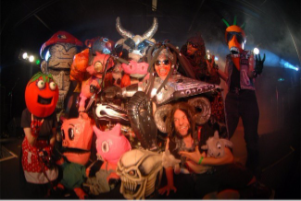
Punk encourages puppets, and puppets encourage punk in return. Green Jelly is not the only punk pioneer to utilize puppets and incorporate them. The 1986 movie Labyrinth stars intricate marionettes alongside a famous icon of the new wave movement, David Bowie. Household objects are brought to life in The Young Ones, a TV show premiering in 1982 with a severely punk rock cast of characters.
The DIY aspect of punk heavily connects itself to puppets. Sock puppets have to be the easiest kind of puppet to make – taking a facet of the nuclear family wardrobe and mutilating it into a living being, a creation, fueled by creativity and passion of punk. This, nevertheless, does not mean that puppets are encouraged where they should be. In fact, puppets and practical effects are being smothered in favor of the traditional CGI blockbuster movie- lacking in creativity, entertainment factor, and uniqueness.
The punk subculture is so connected to puppetry in ways we as standard white bread-bred folk don’t even realize. The sort of “persondrag persona” created by a felt humanoid is punk, the way it’s presented is punk. Everything about the puppet is punk, and has been through time and space.