
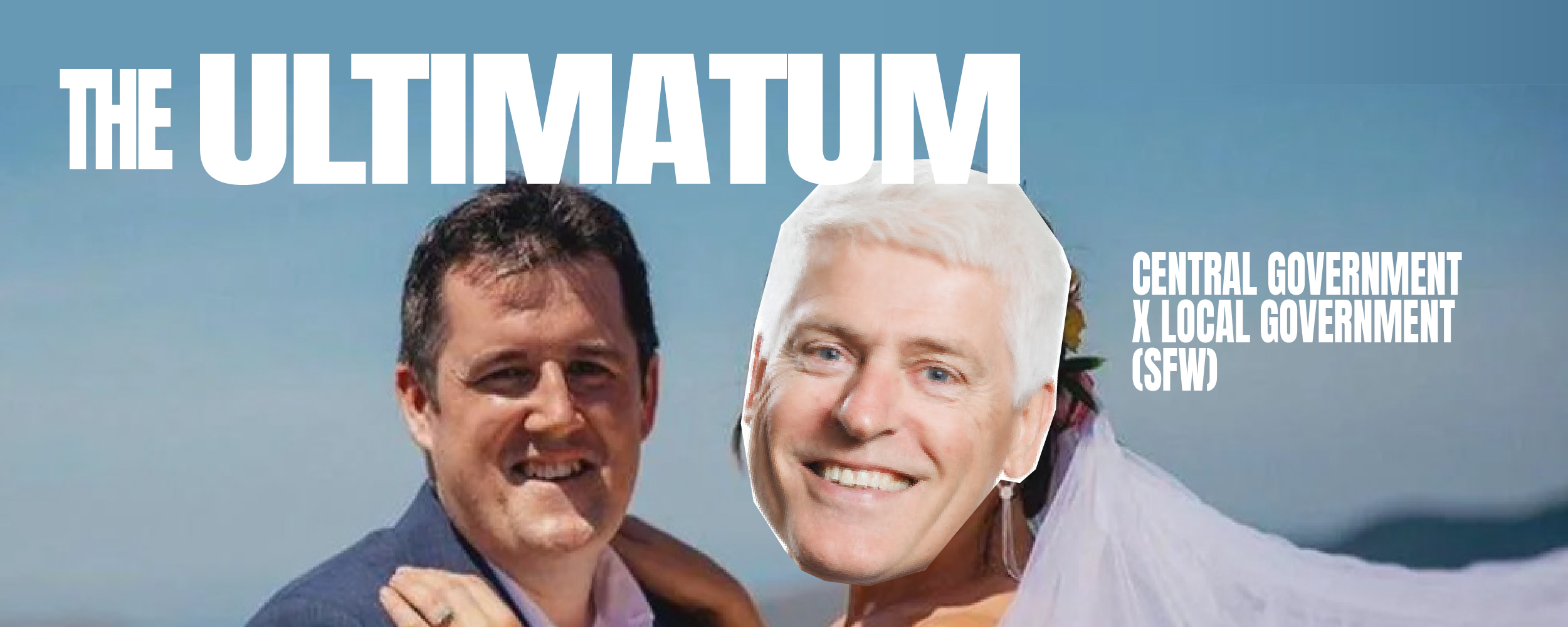

In November of 2025, Minister for Resource Management Act Reform Chris Bishop and Minister for Local Government Simon Watts announced reforms to local government. On Tuesday the 5th of May, they gave councils three months to figure out how they would do it before the New Zealand Government steps in. According to Chris Bishop himself, the reforms will be “the most significant changes to local government since 1989”.
To us here in the Waikato, the most apparent consequence of the reforms is the amalgamation of local government and abolishment of regional councils. As of current, the Waikato Regional Council has separate responsibilities to the ten district councils and Hamilton City Council (HCC) within the Waikato region. The Waikato Regional Council protects regional environmental resources and provides public transport. HCC and the ten district councils are a type of local government known as “territorial authorities”, which are responsible for turning its resident’s rates into local services, such as rubbish collection, parks, and libraries – to name a few.
The Waikato Regional Council is run by a group of Regional Councillors elected in the local body elections, while the territorial authorities are run by a mayor and a group of councillors chosen by the territory’s ratepayers in the same election. Because regional councils oversee an area made up of many territories, there is often a lot of overlap in the responsibilities of the Waikato Regional Council and the city/district councils that lie within it.
What the local government reforms aim to do is to create a not-so-secret third option across the country: Combined Territories Boards.
Combined Territories Boards are comprised of Mayors from the same region that will collaborate to make decisions. Their first order of business is to lead their own reorganization and work out how they can make public services more effective and cost efficient. In November, the central Government gave a few suggestions, from sharing services to amalgamating into one unitary authority that combines the responsibilities of a territorial one and a regional council.
Chris Bishop and Simon Watts initially announced in a statement that Mayors would be able to work together to create plans for reorganisation themselves, to be presented to officers within the new mega-ministry for Cities, Environment, Regions, and Transport (MCERT). The plans would then be tested against criteria that “support national priorities like housing and infrastructure, offer financially responsible arrangements that keep rates manageable, and deliver better services at lower costs”. The opportunity for councils to reorganize themselves would have kept leadership at the regional level, but now an ultimatum has been given to Mayors – if their reorganisation plans are not presented to the government within three months, central Government will be stepping in.
Bishop dismissed concerns that only three months warning would not be enough time for councils to reform, telling the media in a statement that “they can meet the three-month time-frame, honestly local government spends its whole life consulting people.”
Luckily for us, the Waikato Mayoral Forum does not seem to be straggling behind. Last month, Waikato Mayors signed a joint letter to Minister Simon Watts expressing a desire to work together. South Waikato District Council Mayor Gary Petley reassured residents after Central Government’s ultimatum “We [Waikato Mayoral Forum] knew that if we weren’t at the table from the outset then we’d risk losing control over our destiny. We are determined to ensure that is not the case.”
With Chris Bishop making it pretty clear that “regional councillors will not be elected in the 2028 local body elections”, it’s no surprise that the Combined Territories Boards in the Waikato region have joined those in Northland, Bay of Plenty, Wairarapa, and Hawke’s Bay in confirming that they’ll be moving forward with the amalgamation.
Before proposals have even been sent to MCERT, much less approved, it’s difficult to say what exactly the reforms will look like for the Waikato region. What we do know is that no matter what the reorganisation ends up being, change is coming.