
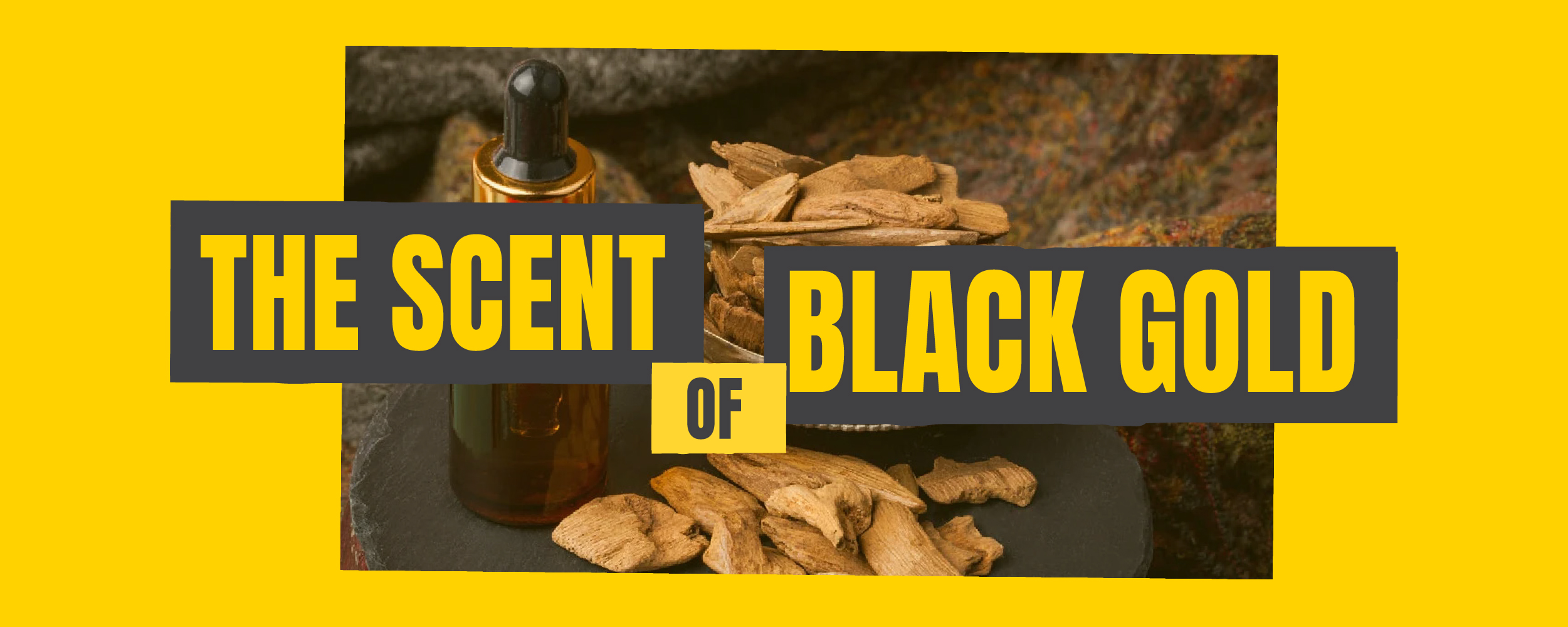

If you are familiar with the world of perfume and fragrance, you have probably come across the word “oud” at some point. A staple on the shelves of fragrance bros around the world, oud is a scent that is widely known but scarcely understood. In fact, oud is the Arabic name for Agarwood, a resinous heartwood that has long been prized for its scent. Worth more than its weight in gold, agarwood has a history that dates back thousands of years and has in recent decades taken off as a fragrance ingredient in the West. However, despite the grandeur often associated with agarwood, its origins are actually rather humble.
Many are surprised to learn that agarwood is the byproduct of fungal infections. When Aquilaria trees become infected, they produce a resin designed to combat fungal growth. As this resin spreads through the wood, the pale Aquilaria wood darkens, producing agarwood as a result. Only 9 of the 21 Aquilaria species produce agarwood, and they can be found across South and South-East Asia. It can take an Aquilaria tree decades to produce a sufficient yield of agarwood, and only about 10% of Aquilaria trees in the wild end up producing agarwood.
Its scent is often described as sweet, musky, and animalic. However, the notes can vary greatly depending on the species of Aquilaria. Despite agarwood’s rarity, it has been prized by many cultures for thousands of years. Agarwood is mentioned multiple times in the Bible as “aloe”, in several Islamic Hadith, and in ancient Indian epics like the Mahabharata. In China, agarwood was prized as a precious incense as well as a sedative. In the Arab world, the burning of agarwood as incense is a deeply rooted tradition that is still alive and thriving to the present day. Agarwood also has a longstanding relationship with Japan, where an elaborate ceremony centred around the appreciation of agarwood incense was created. Even the West has fallen in love with Agarwood, with many famous fragrance houses now producing agarwood-based scents such as Tom Ford’s Oud Wood or Maison Francis Kurkdijan’s Oud Silk Mood.
While agarwood is beloved by many, it has become a victim of its own success. The great demand for agarwood has made Aquilaria trees victims of illegal and unsustainable harvesting. Currently, several species of Aquilaria are on the brink of extinction, and their wild population is estimated to have declined by up to 80% over the last century. Scarcity has also caused the price of agarwood to skyrocket, causing many fragrance houses to look to synthetic agarwood to blend into their scents. Thankfully, sustainable farmed agarwood is becoming more common, where trees are artificially infected to produce the desired effect. Furthermore, Aquilaria trees are also protected by the Convention of International Trade on Endangered Species. However, wild agarwood is still highly prized amongst agarwood connoisseurs, resulting in a black market where some of the highest-grade material is still traded illegally.
Agarwood undoubtably has a long history and will likely continue to increase in popularity. While this has also made agarwood a victim of overconsumption, agarwood is already being produced in places like Malaysia, Cambodia and Thailand in a sustainable way. It is likely that in the near future, more agarwood will be produced like this as the wild population of Aquilaria trees continues to dwindle. However, regardless of whether you love agarwood or are hearing about it for the first time, I hope you have become a little more familiar with the Black Gold of Asia.